
What is Blue Guardian?
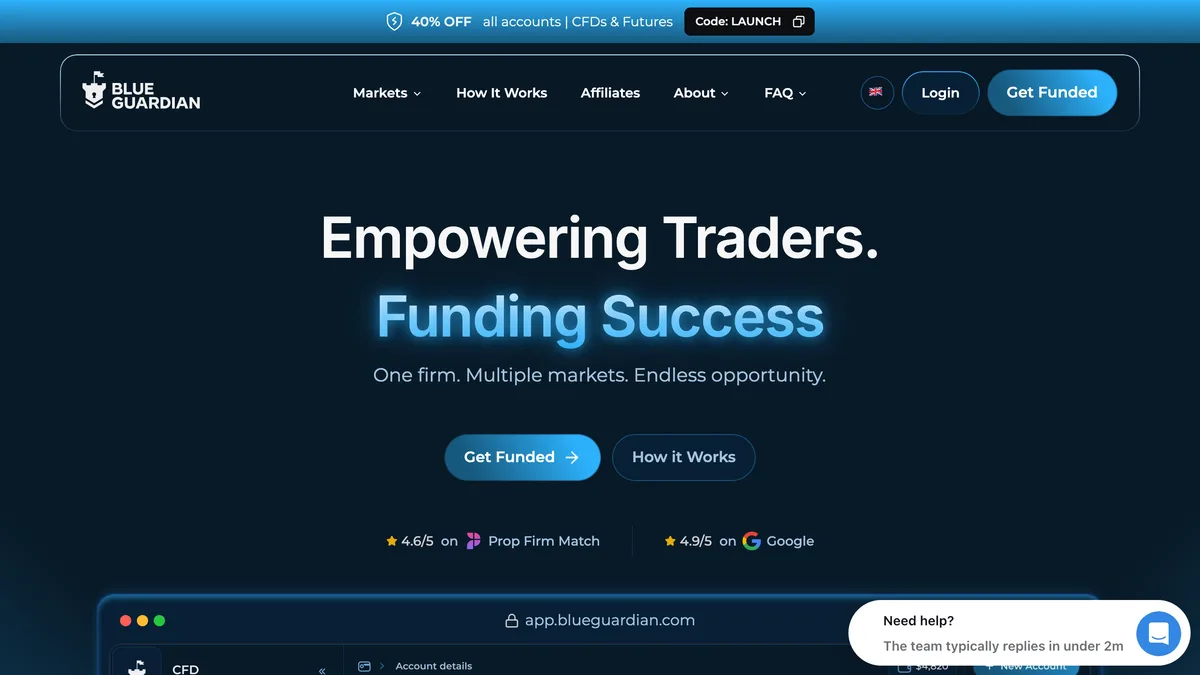
Blue Guardian is a proprietary trading firm that sells simulated-account evaluations. Pass the evaluation, meet the rules, and the firm pays you a share of the notional profits you generate. It is explicit about what it is not, and to its credit it is explicit in writing: “Blue Guardian is not a broker, does not take client deposits, does not hold or manage real client funds, and does not provide financial advisory services of any kind.” It adds that “all trading on the platform ... is only notional trading on a demo account” and that it “is not a licensed investment services provider (securities broker-dealer) within the meaning of MIFID II.”
That is normal. Prop firms are not brokers, and being unregulated is the sector default rather than a scandal. Firms across our best-prop-firms list operate on the same basis. We do not mark Blue Guardian down for being unregulated. We mark it down for the specific, verifiable disorder in its corporate documents.
The product range is unusually wide: eight live models spanning Instant funding, one-step, two-step and three-step evaluations, across MT5, TradeLocker, Match-Trader, NinjaTrader, Tradovate, DeepCharts and TradingView. Maximum leverage is 1:30. The firm survived the February 2024 MetaTrader purge, which killed a large number of its peers, and it claims to have obtained its own MT5 licence and server since.
Our verdict
Blue Guardian scores 4.8 out of 10 and sits at the bottom of our prop-firm ranking. The rules are better than its reputation suggests; the corporate structure is worse than almost anyone realises.
Here is the honest split. The trading rules are, in places, genuinely well designed. The trailing drawdown on five of the eight models tracks a closed-trade high-water mark, in the firm's own words “6% trailing of your Highest Watermark Closing Trade made,” not intraday equity. That distinction matters enormously. Intraday-equity trailing is the mechanic that quietly destroys accounts at other firms, because your unrealised spike ratchets the floor up before you have banked anything. Blue Guardian's version only ratchets on closed trades, and it stops ratcheting altogether once you are 6% up: “If your account reaches 6% of your Initial balance your trailing Drawdown will lock in at your starting balance,” after which a fixed 1% buffer is added. Three further models (1 Step Pro, 2 Step Standard, 3 Step) use a genuinely static drawdown, which the firm's articles label “Maximum Overall Drawdown (Static).” Add no time limit on the evaluation, EAs permitted, and weekend holding permitted, and the rule set is defensible.
What is not defensible is the paperwork around it. Four contradictions, all on primary sources: the entity you contract with; whether your fee ever comes back; what a late payout is worth; and, in practice, what “the drawdown” even means at a firm running five trailing and three static models simultaneously. Any review that calls Blue Guardian “a trailing-drawdown firm” or “a static-drawdown firm” has not read the help centre.
Key features & specs
The table below sets out what we can verify per model. Read it with one caveat firmly in mind: Blue Guardian prices by platform and by model, not simply by account size, and only one rung is directly confirmed at source. We therefore publish “from” pricing anchored on the single confirmed data point rather than inventing a ladder, and rows we could not confirm are marked as such rather than back-filled. The drawdown column is where the real information sits, because it changes character from row to row. Daily loss limits run at 3% of initial balance on Instant Standard, Instant Starter and 1 Step Pro, and 4% on the rest, resetting at 5pm EST. A trading day only counts toward your minimum if you make at least 0.5% profit on it, which is a quiet way of ensuring that idling does not tick the clock forward.
| Attribute | Value | Source |
|---|---|---|
| Firm & track record | Two firm-controlled terms documents name different counterparties. The checkout terms state the site “is operated by Iconic Exchange Limited trading as Blue Guardian,” “registered in England and Wales under company number 12087566,” with “the courts of England and Wales” holding exclusive jurisdiction. UK Companies House shows ICONIC EXCHANGE LIMITED as Dissolved by compulsory strike-off, Final Gazette 6 May 2025. Sole director on that record: BAINTON, Sean Finbar (British, DOB June 2003, resident UAE, appointed 5 July 2019). The main site's terms instead name Blue Guardian Limited (Saint Lucia), Iconic Exchange FZCO (Dubai) and Blue Guardian Marketing LLC (Dubai) under “the laws of the United Arab Emirates.” Year founded is not disclosed on the firm's own site | UK Companies House ↗ |
| Regulatory status | NOT regulated, by design, and the firm says so: “Blue Guardian is not a broker, does not take client deposits, does not hold or manage real client funds, and does not provide financial advisory services of any kind,” and “The Company is not a licensed investment services provider (securities broker-dealer) within the meaning of MIFID II.” All accounts are simulated: “All trading on the platform ... is only notional trading on a demo account.” No regulator (FCA, CFTC, ASIC, CySEC) has warned about or named Blue Guardian, and no lawsuit or class action is on record. This is sector-normal; the problem is not the missing licence, it is the dissolved counterparty | Blue Guardian Terms ↗ |
| Evaluation model | Eight live models: Instant Standard, Instant Starter, 1 Step Standard, 1 Step Pro, 1 Step Crypto, 2 Step Standard, 2 Step Pro, 3 Step. Instant models fund on purchase with no profit target; step models require a target first (1 Step 10%; 2 Step Standard 8% then 4%; 2 Step Pro 10% then 4%; 3 Step 6% in each of three phases). There is no time limit on any evaluation, but a day only counts toward the minimum-trading-day requirement if you make at least 0.5% profit on it | Blue Guardian Help Centre ↗ |
| Account sizes & fees | Sizes $5K–$400K. Blue Guardian prices by platform and model, not by account size alone, and only one rung is directly confirmed at source: the $100,000 “Trading Evaluation - MT5 Instant” at $778 list, taken to roughly $467 by a sitewide LAUNCH 40% coupon that is genuinely live. We do not publish a full ladder because one is not verifiable. The headline $10 Instant Starter price is real (the coupon produces it) and there is no hidden markup, but it caps maximum profit at $250, allows “One payout only,” and then closes: “Once a payout is processed, the account will be permanently closed” | Blue Guardian ↗ |
| Max drawdown | Not one rule but eight, and this is the fact that matters most. FIVE models TRAIL: Instant Standard 6%, Instant Starter 5%, 1 Step Standard 6%, 1 Step Crypto 6%, 2 Step Pro 10%. THREE are STATIC, labelled in the firm's own articles as “Maximum Overall Drawdown (Static)”: 1 Step Pro 6%, 2 Step Standard 8%, 3 Step 8%. Crucially the trailing variant tracks a CLOSED-TRADE high-water mark, not intraday equity: “6% trailing of your Highest Watermark Closing Trade made.” It also locks: “If your account reaches 6% of your Initial balance your trailing Drawdown will lock in at your starting balance,” after which “a fixed 1% buffer” is added. Daily loss is 3% of initial balance (Instant Standard, Instant Starter, 1 Step Pro) or 4% (all other models), resetting at 5pm EST | Blue Guardian Help Centre ↗ |
| Profit split & payouts | 80% Instant Standard, 85% challenge-funded, 90% Instant Starter or via a paid add-on. First payout 14 calendar days after the first trade (7 with a paid add-on), then every 14 days. Minimum $100 via crypto or $500 via Rise. “Payouts are processed within 24 business hours.” “All payouts are subject to a 2% processing fee.” Instant Standard accounts of $200k and above have their first two payouts capped at $10,000 each. Late-payout compensation is promised twice, incompatibly: the homepage says “Funds in 24 hours, or we pay 100% of the profits. Guaranteed,” while the help centre says “you will automatically receive $1,000 in compensation.” Scaling is by merging accounts up to $400K total | Blue Guardian Help Centre ↗ |
| Platform & products | MT5, TradeLocker, Match-Trader, NinjaTrader, Tradovate, DeepCharts and TradingView. Maximum leverage 1:30. The firm claims its own MT5 licence and server (blog, 4 May 2025). The underlying broker and liquidity provider are NOT disclosed and have not been named since Eightcap withdrew prop-firm brokerage in February 2024; the ASIC-licensed broker Blue Guardian announced it was acquiring in late February 2024 has never been identified and no AFSL has been confirmed. The restricted-countries article 404s on the firm's own site, and spreads, commissions, instrument counts and max lot size are not published | Blue Guardian ↗ |
| Guardian Shield | The firm's signature risk mechanic, and its most-complained-about rule. It auto-closes ALL open trades when floating loss reaches 1% (Instant accounts) or 2% (all other accounts). The first activation is a soft breach that permanently cuts the profit split to 50%; a second activation closes the account. The firm describes the cut as going “from 80% to 50%,” which does not map cleanly onto its own 85% and 90% accounts, so a trader on an 85% split cannot tell from the documentation what they would actually drop to. This is not an allegation: it is the firm's own published design | Blue Guardian Help Centre ↗ |
Pricing & value
The one confirmed price point is the $100,000 “Trading Evaluation - MT5 Instant” at $778 list, reduced to roughly $467 by a sitewide LAUNCH 40% coupon that is genuinely live. That is towards the upper end of the market for a $100K instant-funding product, though not outrageous for the category.
The $10 Instant Starter deserves a paragraph of its own, because it is the headline that pulls traffic and it is the product least likely to reward the buyer. The $10 price is real; the coupon produces it and there is no hidden markup. What the marketing does not compute for you is the ceiling. The Instant Starter caps maximum profit at $250, allows one payout only, and then, in the firm's words, “Once a payout is processed, the account will be permanently closed.” It carries a 15% consistency rule and a 90% split, and duplicate accounts are auto-breached without refund. So the best possible outcome from a $10 purchase is a single payout of up to $250, minus the 2% payout processing fee, after which the account self-destructs. That is a fine lottery ticket. It is not a route to funding, and it should not be read as one.
Then there is the refund question, where the firm contradicts itself three ways. The main refund policy says “Once a purchase has been made and the evaluation credentials have been emailed to the customer, no refunds under any circumstances will be accepted” and “All sales are final.” The checkout refund policy says “you will receive a refund of the initial evaluation fee you paid ... with your first successful profit split payment.” The firm's blog says the refund arrives only after the fourth payout, and never on the Instant Starter. Three firm-controlled documents, three different promises. Our position is that a buyer should assume the fee is not coming back, price the challenge accordingly, and treat any refund as a bonus.
Profit splits are competitive on paper: 80% on Instant Standard, 85% on challenge-funded accounts, 90% on Instant Starter or via a paid add-on. All payouts carry a 2% processing fee. First payout comes 14 calendar days after your first trade, or 7 with a paid add-on, then every 14 days. Minimum $100 by crypto, $500 via Rise.
$778 list for the $100K MT5 Instant evaluation, roughly $467 with the live sitewide LAUNCH 40% coupon. Refund status is contradicted across three firm documents (main policy says all sales final; checkout says refunded with your first payout; the blog says after the 4th payout and never on Instant Starter), so we treat the fee as non-refundable.| Account size | Fee | Profit target | Max drawdown | Profit split |
|---|---|---|---|---|
| $100K Instant (MT5) | $778 list / ~$467 with LAUNCH 40% | None (funded on purchase) | 6% TRAILING (closed-trade HWM), locks at start + 1% buffer | 80% |
| Instant Starter ($5K) | $10 with LAUNCH 40% | None (funded on purchase) | 5% TRAILING (closed-trade HWM) | 90%, capped at $250 profit, one payout, then closed |
| 1 Step Standard | Not publicly confirmed | 10% | 6% TRAILING (closed-trade HWM) | 85% funded |
| 1 Step Pro | Not publicly confirmed | 10% | 6% (Static) | 85% funded |
| 1 Step Crypto | Not publicly confirmed | 10% | 6% TRAILING (closed-trade HWM) | 85% funded |
| 2 Step Standard | Not publicly confirmed | 8% then 4% | 8% (Static) | 85% funded |
| 2 Step Pro | Not publicly confirmed | 10% then 4% | 10% TRAILING (closed-trade HWM) | 85% funded |
| 3 Step | Not publicly confirmed | 6% per phase (×3) | 8% (Static) | 85% funded |
Legitimacy & payout safety
This is the section that decides the score. Start with who you are contracting with. The checkout terms name Iconic Exchange Limited, England and Wales, company number 12087566, with exclusive jurisdiction in the English courts. Companies House shows that company Dissolved, struck off, Final Gazette 6 May 2025. The sole director on that record is Sean Finbar Bainton, British, born June 2003, resident in the UAE, appointed 5 July 2019. Meanwhile the main site's terms name a completely different set of entities: Blue Guardian Limited (Saint Lucia), Iconic Exchange FZCO (Dubai) and Blue Guardian Marketing LLC (Dubai), under “the laws of the United Arab Emirates” with disputes heard in Dubai. So the document at the till points you to an English forum where the counterparty no longer exists, while the document on the website points you to Dubai. If your payout is denied, your first problem is not the merits. It is working out who you are even suing.
On regulation, there is none, by design, and the firm says so plainly. That is sector-normal and we treat it as such. No regulator has warned about or named Blue Guardian. There is no lawsuit and no class action. We want to be precise about this, because the internet is loud: the unregulated status is not the problem here. The dissolved counterparty is.
Payout proof is the next weak point. The widely-repeated “$20 million in total payouts” figure traces to a paid press release (26 February 2026, PulseBulletin, carried on FinancialContent, syndicated via FinanceWire), which names Iconic Exchange FZCO as operator, and which the carrying site disclaims outright: “This article is third-party content and does not represent the views of this site. We make no guarantees regarding its accuracy or completeness.” The firm's own blog says $21M. Third-party review sites cite $23.8M. There is no audit, no third-party payout certification, and no independent verification anywhere. We will not write that Blue Guardian has paid out $20 million, because nobody has established that. The figure is self-reported, internally inconsistent, and distributed through paid wires.
Then there is the discretion clause, which you should read twice before you buy.
“The Company reserves the sole and absolute discretion to determine any breach and may, without prior notice, take action including account suspension or termination, trade voiding, profit/loss adjustments, payout denial.”
Blue Guardian Terms of Service, Blue Guardian Terms & Conditions, breach and enforcement, accessed July 2026 TOS ↗
Most prop firms have something like it. Few pair it with a dissolved contracting entity.
Guardian Shield is the firm's signature mechanic, and it auto-closes every open trade when floating loss reaches 1% (Instant) or 2% (other accounts). The first activation is a soft breach that permanently cuts your profit split to 50%. A second closes the account. Note the wording problem: the firm describes the cut as going “from 80% to 50%,” which does not map onto the 85% and 90% accounts at all. We flag that rather than paper over it, because a trader on an 85% split cannot tell from the documentation what they would actually drop to. Guardian Shield is the single most-complained-about rule at this firm, and it is not an allegation. It is the firm's own published design.
On sector risk, the February 2024 shakeout hit Blue Guardian directly. MetaQuotes squeezed brokers over MT4 and MT5 licensing. Blue Guardian halted new MetaTrader customers via its then-broker Purple Trading SC and named Eightcap as the fallback. On 15 February 2024 Eightcap cut brokerage services to all prop firms effective 29 February, naming Blue Guardian among those affected, so the fallback evaporated within days. Blue Guardian restricted new US registrations on 19 and 20 February 2024 and announced it was acquiring an unnamed ASIC-licensed broker. Two years on, that broker has still never been named and no AFSL has been confirmed. Blue Guardian survived the purge, which is a real achievement most MetaTrader-era props did not manage. But it has never disclosed who executes its flow, its restricted-countries article 404s on its own site, and it publishes no spreads, commissions, instrument counts or max lot size. The opacity is itself a finding.
What traders say
The picture is not “scam,” and it is not “clean.” It is bimodal in a way that is worth describing carefully. Blue Guardian's main Trustpilot profile currently displays no TrustScore at all. Trustpilot displays a notice that the rating is unavailable due to a breach of its guidelines, and states that it has removed a number of fake reviews for the company. The profile renders under the display name “Guardian Markets.” We reached this through search-engine extraction of the live page rather than a direct fetch, so we describe rather than quote it. We are publishing no TrustScore for that profile, and readers should discount the 3.5 to 4.2 figures floating around third-party sites: they are stale and predate the suppression.
A separate Trustpilot profile for blueguardianfutures.com, display name “Blue Guardian,” claimed in November 2024, shows 3.9 out of 5 from 999 reviews. The distribution is a barbell: 63% five-star, 21% one-star, almost nothing in between. That shape usually means two populations, not one consensus. There is an observable pattern of one-line five-star reviews posted minutes apart and reviews written before the reviewer has traded or been paid. We describe the pattern because it is observable. We do not allege an incentive scheme, because that link is inference, not evidence. ForexPeaceArmy, meanwhile, shows 1 out of 5 from 6 reviews, all complaints, dated July 2025 to May 2026.
PropFirmMatch is the most useful source because it tags reviews as “Yes Payout” or “No Payout.” Ten reviews: four paid, six denied. Among the paid, Pablo (DE, 22 March 2026) titled his “MISSING PAYOUT - RESOLVED” and received $4,229 only after escalating. The honest synthesis is that the firm does pay, and small early payouts are repeatedly confirmed. The complaints cluster at the large first payout, where traders report a compliance allegation arriving instead of the money. Abdallah (YE, 9 June 2026) writes that “after passing my evaluation and earning a $785 profit, they banned my account (#440702) and confiscated my earnings, citing a ‘Shared Device' violation.” Anna (US, 30 May 2026) reports a denial on device and connection matching after months of successful payouts. Mo (US, 6 July 2026) claims the daily loss limit changed from a soft to a hard breach without notice, which is his allegation and not something we can establish. On ForexPeaceArmy, Elora Gracious (NG, 18 May 2026) writes: “Your stop loss means nothing on Blue Guardian. They will close you above your SL, blame spread, trigger their Guardian Shield, and then tell you it's your fault.” In these reports, no trade-level evidence is supplied by the firm.
One observation we will state but not diagnose: on PropFirmMatch, every payout-received report dates from March 2026 and every denial from May to July 2026. That is a sample of ten on one low-traffic aggregator, with no control for when the firm was listed there. It is texture, not proof of a trend, and we do not treat it as one.
| Platform | Score | Sample | Source |
|---|---|---|---|
| ForexPeaceArmy | 1.0 / 5 | 6 reviews, all complaints, dated Jul 2025 to May 2026 | Source ↗ |
| Trustpilot (separate blueguardianfutures.com profile) | 3.9 / 5 | 999 reviews; 63% five-star, 21% one-star. Futures-domain profile, claimed Nov 2024. The main blueguardian.com profile displays no TrustScore | Source ↗ |
| PropFirmMatch | 4 “Yes Payout” vs 6 “No Payout” | 10 tagged reviews; payouts received cluster Mar 2026, denials May–Jul 2026 | Source ↗ |
| Aggregate | No rating | Main Trustpilot profile shows no TrustScore; Trustpilot notes a guidelines breach and fake-review removal (12 Jul 2026) | Normalized by TheFXGeek |
“My Experience with Blueguardian Is Awesome Took First Payout 205$ From 5k Instant Starter account that i bought it with 10$ only.. Thank you Blueguardian..”
Surajit (IN), 5.0 stars, tagged “Yes Payout”, PropFirmMatch, 12 Mar 2026 source ↗
“It was all fine and good until the time of payout came(1300$). The behaviour of customer care changed, they flagged a violation on my account and blocked me out of my login, discord community etc. This itself is a proof that something is gravely wrong in the way the firm works.”
Brijesh (IN), 1.0 star, tagged “No Payout”, PropFirmMatch, 19 Jun 2026 source ↗
Pros & cons
The strengths here are real and mostly live in the rulebook. The weaknesses live in the corporate paperwork and in what happens when the payout gets large. Both lists below are drawn only from verified sources: the firm's own documents, the UK public register, industry press and dated public user reports.
- Trailing drawdown tracks a closed-trade high-water mark, not intraday equity (“6% trailing of your Highest Watermark Closing Trade made”), which is materially more forgiving than the intraday trailing used by several rivals
- The trailing drawdown locks: once the account reaches 6% above the initial balance it fixes at the starting balance, with “a fixed 1% buffer” added on top
- Three of the eight models (1 Step Pro, 2 Step Standard, 3 Step) use a genuinely static drawdown, labelled as such in the firm's own help centre
- No time limit on any evaluation, so there is no artificial pressure to overtrade
- EAs are allowed, and overnight and weekend holding are both permitted
- Small payouts are repeatedly confirmed as landing fast, with a $100 crypto minimum and a documented 24-business-hour processing target
- Wide platform range: MT5, TradeLocker, Match-Trader, NinjaTrader, Tradovate, DeepCharts and TradingView
- Survived the February 2024 MetaQuotes and Eightcap shakeout that ended a large number of its peers, and has continued operating and paying since
- The checkout terms name a dissolved company: “Iconic Exchange Limited ... registered in England and Wales under company number 12087566,” which Companies House shows as Dissolved by compulsory strike-off, Final Gazette 6 May 2025
- The main site's terms name three entirely different UAE and Saint Lucia entities under UAE law, so the two documents disagree on both counterparty and jurisdiction
- Three incompatible refund policies: main policy says “All sales are final,” checkout promises a refund “with your first successful profit split payment,” the blog says only after the 4th payout and never on Instant Starter
- Denied-payout complaints cluster at the large first payout, with compliance allegations and no trade-level evidence supplied; PropFirmMatch tags 6 of 10 reviews “No Payout” and ForexPeaceArmy sits at 1/5
- Main Trustpilot rating is suppressed: the profile shows no TrustScore, with Trustpilot noting a guidelines breach and the removal of fake reviews
- Payout totals are self-reported only: the “$20 million” figure comes from a paid press release the carrying site itself disclaims, while the firm's blog says $21M
- Guardian Shield permanently cuts the profit split on first activation and closes the account on second, described as a cut “from 80% to 50%” that does not map onto the firm's own 85% and 90% accounts
- The executing broker has not been named since February 2024, and the promised ASIC-licensed broker acquisition has never been identified
Blue Guardian vs alternatives
Against the top of our list, the gap is structural rather than a matter of percentage points. FundingPips (7.4) and Tradeify (7.3) do not present a buyer with three mutually contradictory refund policies, and neither names a dissolved company at checkout. Topstep (7.2) and Apex Trader Funding (7.1) publish long, boring, consistent payout histories that do not depend on a paid press release for their headline number. On raw mechanics Blue Guardian competes: a closed-trade high-water-mark trailing drawdown that locks is more forgiving than the intraday-equity trailing several futures firms still use, and three static-drawdown models plus no time limit is a better deal than a lot of the field advertises.
Against Goat Funded Trader (5.7), previously the last name on our list, Blue Guardian has the better drawdown design and the wider platform range but a materially worse legitimacy profile: a suppressed Trustpilot rating for a guidelines breach and fake-review removal, a 1/5 on ForexPeaceArmy, an undisclosed broker, and a contracting entity that no longer exists. That is what puts it below. If you want the Blue Guardian rule set, the honest advice is to find a firm offering something close to it with a company you could actually serve papers on.
How Blue Guardian compares to the next tools in our prop firms ranking:
| Metric | Blue Guardian | FundingPips | Tradeify |
|---|---|---|---|
| Our score | 4.8/10 | 7.4/10 | 7.3/10 |
| Starting price | From ~$467 evaluation | From $36 evaluation | From $99 one-time |
| Best for | Small, fast payouts on a forgiving closed-trade trailing drawdown, for traders who accept they may never enforce the contract | Disciplined traders who want low-cost, no-time-limit evaluations with verifiable payouts | Disciplined intraday futures traders who want one-time fees and a forgiving EOD-trailing drawdown |
| Regulation | Offshore | Offshore | Offshore |
| Full review | This page | FundingPips review → | Tradeify review → |
In short: FundingPips edges ahead of Blue Guardian in the overall ranking, but small, fast payouts on a forgiving closed-trade trailing drawdown, for traders who accept they may never enforce the contract is where Blue Guardian makes its strongest case.
Who is Blue Guardian for?
Use Blue Guardian if…
Use Blue Guardian if you are buying a small ticket with money you can lose, you understand exactly what the $10 Instant Starter is (one payout, a $250 ceiling, account closed afterwards), and you want to test a rule set that includes closed-trade trailing, a static option on three models, no evaluation time limit, EAs and weekend holding. Traders who withdraw small and withdraw early appear to get paid, repeatedly and quickly.
Skip it if…
Skip it if you intend to scale toward a four-figure or five-figure payout. That is precisely where the complaint pattern concentrates, and it is precisely where the contradiction at the checkout stops being an academic curiosity. If a firm invokes its “sole and absolute discretion” against you, your recourse depends on there being a company at the other end of the contract. Per the document you agreed to at the till, there is not one.
Final verdict
Blue Guardian is a functioning prop firm with a better rulebook than its reputation and a corporate structure worse than almost any reader realises. The drawdown design deserves credit: closed-trade high-water-mark trailing that locks at breakeven plus a 1% buffer is genuinely more forgiving than the intraday-equity trailing used elsewhere, and three of the eight models are outright static. There is no time limit, EAs are allowed, weekends are allowed, and small payouts land fast.
Set against that: the checkout terms bind you to a company dissolved in May 2025; the main terms name three entirely different entities in a different jurisdiction; the refund policy exists in three incompatible versions; the homepage promises “100% of the profits” for a late payout while the help centre promises $1,000; the executing broker has not been named in over two years; the restricted-countries policy 404s; the $20 million payout figure is self-reported through a paid PR wire and contradicted by the firm's own blog; and the main Trustpilot rating has been suppressed for a guidelines breach with fake reviews removed.
The trade-off is stark. You may well get paid, especially early and especially small. But you are buying a promise from an entity that, on the firm's own controlling document, does not exist, and enforcement of that promise rests on a clause giving the firm “sole and absolute discretion” over every breach determination. That is not a price worth paying for a good drawdown rule. Bottom of our list. We score it 4.8 out of 10.
One of the better-designed drawdown rule sets in the sector, sold under checkout terms that bind you to a company dissolved in May 2025. Open a demo account to try the platform risk-free, then fund a live account when you're ready. Trading carries risk.
Try Blue GuardianFrequently asked questions
More Prop Firms reviews
 FundingPips
FundingPips pairs one of the few independently on-chain-verified payout records in the sector with a strict, discretion-heavy rule book and no regulatory protection.
 Tradeify
A genuinely-paying futures prop firm with cheap one-time entry and a friendlier end-of-day trailing drawdown, tempered by strictly non-refundable fees, aggressive enforcement, and self-reported-only payout proof.
 Topstep
Topstep pairs a fairer end-of-day trailing drawdown and fast payouts with a current cluster of outages, a data breach, and an active lawsuit you should weigh before buying.