


How forex copy trading actually works
Copy trading links your account to a strategy provider's so that when they open, modify, or close a position, your account does the same, sized to the capital you have allocated rather than to their balance. Most platforms run this through one of three engines. Proportional copying scales every trade to the ratio between your allocation and the provider's equity, so a provider risking one percent of their account risks roughly one percent of yours. Fixed-lot mirroring copies the same lot size regardless of account size, which can quietly over-leverage a small balance. Mirror or PAMM-style pooling sits closer to a managed account, where your money tracks a combined pool. The mechanics matter because they decide how much risk you inherit from a single click, and they are rarely spelled out on the marketing page. Before allocating a cent, find out which model a platform uses, whether copying is one-to-one or proportional, and what happens to an open copied trade if you stop following mid-position.
Who copy trading suits, and who it doesn't
Copy trading is built for people who want exposure to active forex strategies without sitting at the charts, and for newer traders who want to learn by watching real positions play out. Used carefully, it can diversify across several providers and styles and remove some of the emotional decisions that sink discretionary traders. It is a poor fit, though, for anyone who treats it as passive income or a substitute for understanding risk. The trades are still in your account, the leverage is still yours, and a provider's run of good months tells you very little about the next bad one. If you would not be comfortable holding the underlying positions yourself, copying them automatically does not make them safer; it just removes your hand from the wheel while leaving your capital on the road.
The risks a leaderboard won't show you
The numbers that sell copy trading are the ones most worth distrusting. A leaderboard sorted by return naturally floats the providers who took the most risk and got lucky, while survivorship bias quietly deletes everyone who blew up, so the board you see is the winners' table, not the average outcome. Headline gains are often shown far more prominently than maximum drawdown, even though drawdown is the better predictor of whether a strategy will hurt you. Some published track records come from demo accounts that never felt real slippage or a margin call. And copy slippage, the gap between the provider's fill and yours, means even an honest record is not exactly what you will earn. Treat every advertised figure as past performance that does not guarantee future results, and weight verified, real-money, full-history records far above a glossy percentage.
Copy trading vs PAMM, MAM, and managed accounts
These terms get used interchangeably, but the control you keep is different in each. With copy trading the positions execute in your own account, you choose who and how much to copy, and you can stop or close everything yourself at any time, which makes it the most transparent and reversible option. A PAMM (Percentage Allocation Money Management) or MAM (Multi-Account Manager) pools or links accounts under a manager who trades them as a block, so your money moves with the pool and you have less day-to-day control. A discretionary managed account hands a manager actual authority over your capital under a mandate. None of these removes market risk, and all of them depend on the provider's edge continuing, but copy trading's ability to pull out fast is its main structural advantage, and it is the model the platforms in this category are judged on.
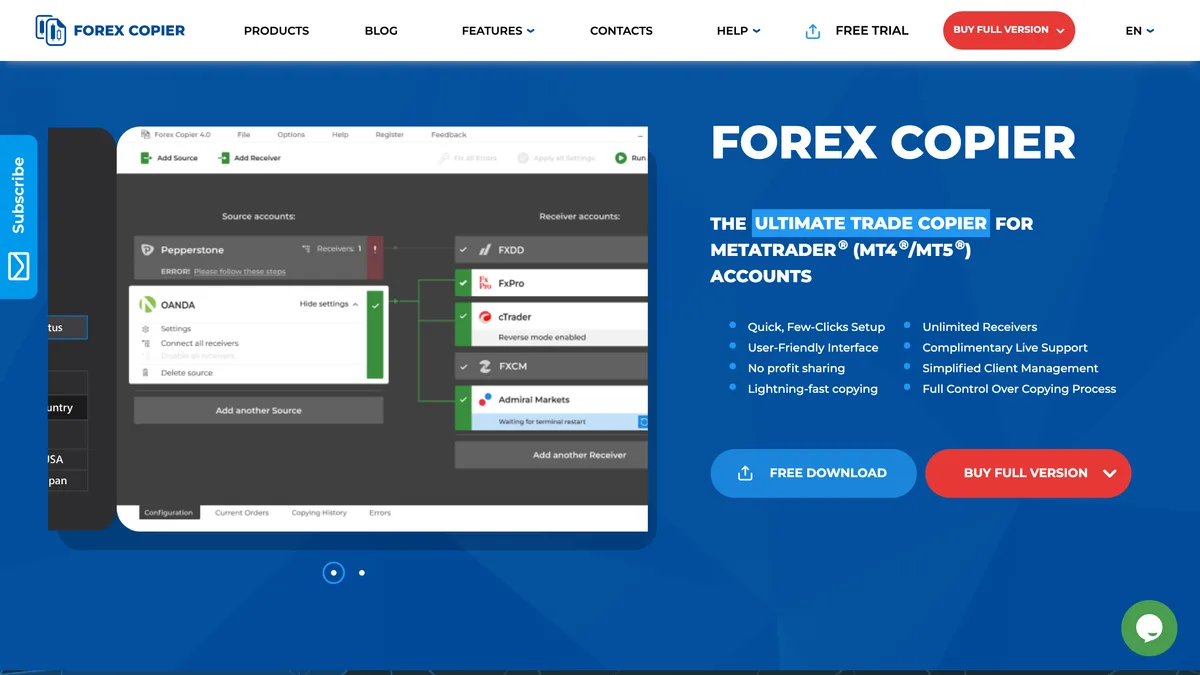
Verdict: Buy Forex Copier for the control set, not for the story: risk-percent sizing, a drawdown cap and an emergency stop for $199 once is real value, and your funds never leave your own broker. But the false “turns any losing EA into a profitable one” claim, a guarantee that appears nowhere in the contract, and three FPA five-star reviews zeroed as fakes mean you should trust the software considerably further than you trust the vendor.
| Attribute | Value | Source |
|---|---|---|
| What it is | Licensed Windows desktop trade-copier software that replicates orders between MetaTrader and cTrader terminals. It is not a broker and not a social copy-trading network: there is no fund custody, no financial licence, no strategy-provider leaderboard, no performance fee and no profit share. Your money stays wherever you already trade. Forex Peace Army files it under “Trading Software,” not brokers and not copy trading, which is the correct shelf. | Forex Copier ↗ |
| Company & transparency | The privacy policy names the operator as “Forex Tester Software Inc, a company registered under the laws of the Province of Ontario,” the same company behind the Forex Tester backtesting product. No company registration number, no street or mailing address and no named officers are published anywhere on the site; we checked the homepage footer and the privacy policy. The site's own copyright line reads “© 2006-2026” while third-party company records list 2010, so we could not verify a founding date. | Forex Copier privacy policy ↗ |
| Editions (both shipped) | Forex Copier 4 is the local copier: every terminal, source and receiver, must run on the same PC or VPS. It supports MT4, MT5 and cTrader, and is sold as a one-time licence. Forex Copier Remote 2 copies over the internet to receivers on other machines and is explicitly pitched at people who want to sell trading signals; it covers MT4 and MT5 only, with cTrader not mentioned, and is sold as an annual subscription or a one-time “lifetime” licence. Both are Windows only. macOS is NOT shipped: the vendor says only that it is “working hard to provide such opportunity in the nearest future.” | Forex Copier 4 ↗ |
| Copy mechanics & sizing | Sizing can be a lot multiplier (including per-symbol multipliers), a fixed lot, an “Auto Adjust Lot Size” by source/receiver balance or equity ratio, or a risk-percent rule the vendor describes as “each order will risk no more than selected % of your account size.” Symbol names are matched automatically across brokers, with manual prefix and suffix handling. Filters cover currency pair, comment (wildcard or partial match), order type (Buy/Sell/Stop/Limit/pending) and magic number. SL/TP can be ignored, set to custom fixed values, or shifted by the price difference between brokers. Partial closes mirror proportionally, and “Close By” opposite-order closing is supported. | Forex Copier features ↗ |
| Risk controls | This is the product's genuine strength. A Max Lot Size cap, a “Price difference” maximum-deviation and slippage control, and “Wait For Better Price” all ship as standard. Forex Copier 4 adds an emergency stop, equity-based suspension of copying, and a drawdown-percent limit. Together these let a copier bound their downside independently of whatever the source account decides to do, which is more than most copiers in this price band offer. Documented copy slippage is a different matter: the vendor publishes no slippage data and no independent latency benchmark of this product exists. | Forex Copier features ↗ |
| Strategy providers & leaderboard | There are none, and that is the finding. Forex Copier hosts no traders, publishes no leaderboard, shows no track records (verified or self-reported, live or demo) and pays no performance fee or profit share. The category's usual central danger, a leaderboard of demo or self-reported returns with the failures quietly deleted, cannot exist here. You choose the source account yourself, so the entire diligence burden, whether a source's history is live or demo, how deep its drawdown ran, and how long it goes back, sits with you. | Forex Copier ↗ |
| Reverse Mode: the claim, and why it fails | The homepage sells “Turn losses into gains with our unique Reverse Mode” and says the software is “converting their losses into your gains.” The blog goes further: “Turns any losing EA into a profitable one,” and “if source account's order is losing then on receiver side there will be profitable order.” That last claim is false, not merely unsupported. Two accounts taking opposite sides of the same trade do not sum to zero, they sum to a loss, because both pay spread, commission and swap. The reverser therefore profits only when the source loses by MORE than both accounts' trading costs combined; any source trade closing at a loss smaller than that combined cost produces a loss on the reversed side too. There is always a band of losing strategies whose inverses also lose, which is exactly why the word “any” breaks the claim. Neither blog post contains a single backtest, data point, case study, or any mention of spread, commission or swap on the reversed side. The feature itself is legitimate (hedging, diagnostics, and the narrow case of a system whose negative expectancy genuinely exceeds both sides' costs) and it is not unique: FX Blue's free Personal Trade Copier lists trade-direction inversion among its settings too. | Forex Copier blog ↗ |
| The EULA contradicts the architecture | The Remote Provider EULA states, verbatim: “The Software neither collects nor transmits any of your data. All data used by the Software in the course of its operations remains unchanged and stored on your device.” The Remote 2 product page's own “How it works” diagram routes every trade through an “FCR 2 Server” operated by the vendor, on the path from your terminal to your client's, labelled 0.6 seconds. The most charitable reading, and we think the correct one, is that this is reused boilerplate from the local-copier agreement that does not describe Remote 2's actual data flow. Either way, the binding document a Remote buyer signs misdescribes where their trade data goes. | Remote Provider EULA ↗ |
| Regulation & fund custody | Forex Copier holds no client money, so there is nothing to segregate and nothing to freeze; your funds stay at your existing broker under that broker's regulation. That is a real and underrated advantage. It also means no financial licence, no negative-balance protection and no compensation scheme, and none of those are claimed. Being unregulated is normal for a desktop software product and we do not treat it as a scandal. No regulator warning naming this product or Forex Tester Software Inc. was found in the OSC or CIRO investor-alert indexes, which is “no warning found” rather than regulatory clearance. What it does mean is that your only recourse is the vendor, whose EULA provides the software “AS IS” and disclaims “ANY DAMAGES BOTH DIRECT OR INDIRECT, INCLUDING, INTER ALIA, LOST PROFIT, LOST DATA.” | Remote Provider EULA ↗ |
| Vendor claims (unaudited) | The FC4 page advertises “0.1 seconds to copy any trade. Every trade.” and the Remote 2 diagram labels its path 0.6 seconds. No independent benchmark of either figure exists anywhere and the vendor publishes no methodology, so treat both as advertising rather than measurement. The FC4 page also claims it is “Trusted by 4,972 traders across 122 countries,” a vendor figure with no supporting source. Separately, one thing a copier buyer usually wants to know is not disclosed anywhere in the documentation: whether the software needs a full trading password or a read-only investor password on the source account. | Forex Copier 4 ↗ |
| Maintenance | The most recent build listed by an independent mirror is dated 15 October 2025, and the vendor publishes no dated changelog, so we cannot confirm what has shipped since. No malware reports were found for the installer. Licensing is machine-locked: “one computer - one license. Software is attached to your computer and cannot be registered with the same key on another computer(s),” with a free key transfer if the machine crashes or is replaced. | FileHorse (independent mirror) ↗ |
| Platform | Score | Sample | Source |
|---|---|---|---|
| Trustpilot | 3.7 / 5 | 73 reviews (86% five-star lifetime, but only 3 reviews in the last 12 months and the recent ones negative) | Source ↗ |
| Forex Peace Army | 1.312 / 5 | 6 reviews (three five-star ratings zeroed by moderators for IP and information overlap with the company's own FPA representative) | Source ↗ |
| Aggregate | 3.7 / 5 (Trustpilot) | 73 Trustpilot reviews; 6 on Forex Peace Army, where three five-star ratings were stripped as apparent fakes | Normalized by TheFXGeek |
“We offer an unconditional 30-day money back guarantee. If you don't like our copy trading system for whatever reason, we will return the whole amount you paid us.”
Forex Copier Terms of Service, 30 Days Of The Money Back Guarantee (marketing copy; neither EULA contains any refund clause at all), accessed July 2026 TOS ↗
One-time desktop licence (Forex Copier 4). No subscription, no profit share, no high-water mark. Trading costs are your own broker's spread and commission on both the source and the receiver account. Remote 2 is priced separately, from $299, annual or lifetime.“The support these guys offer is amazing! They come back in queries so quickly and really try and resolve issues. I have used the forex copier now for over 3 years and I cant think of changing. The functionality and features of the programme is just top notch.”
Kaizen (AU), Trustpilot (unprompted review), Mar 2025 source ↗
“It misses trades sometimes. I tried every possible config to avoid mistakes but it still fails sometimes, not much. I run it under Windows Server 2022 in VPS to copy orders among Metatrader 5 accounts only. It can still be usefull if you are swing trader, take small risk per trade and can check the app orders tracking once a day or so.”
Davidemejota (ES), Trustpilot (unprompted review), Feb 2026 source ↗
- Deep risk controls for a one-time price: risk-percent sizing, auto-adjust by balance or equity ratio, max lot cap, drawdown-percent limit, equity-based copying suspension and an emergency stop
- $199 one-time pays for itself against cloud rivals inside a year (Duplikium from €9.00/mo per account; Social Trader Tools around $20/mo for two accounts), then keeps running for nothing
- No fund custody at all: money stays with your existing regulated broker, so there is nothing for a software vendor to freeze, lose or delay
- No leaderboard, so no demo, self-reported or survivorship-biased provider track records are being sold to you
- Granular copy filtering by currency pair, comment (wildcard match), order type and magic number, plus automatic cross-broker symbol matching with manual prefix and suffix handling
- The local edition supports MT4, MT5 and cTrader; SL/TP can be ignored, replaced with fixed values or shifted by the broker price difference; partial closes mirror proportionally
- A real 30-day trial, capped at two source-plus-receiver accounts, before you pay anything
- The vendor replies to 100% of negative Trustpilot reviews, typically within 24 hours, on a profile Trustpilot itself flags as unsolicited
- The flagship Reverse Mode claim, “Turns any losing EA into a profitable one,” is false by arithmetic, not merely unsupported: both sides pay trading costs, so the reverser profits only when the source loses by more than both accounts' costs combined, and the vendor publishes no data, backtest or caveat
- The Remote 2 page invites self-identified weak traders to sell signals so subscribers can reverse them, while the vendor's own Provider EULA warns signal-selling “could be subject to regulation and require additional authorization”
- The “unconditional 30-day money back guarantee” appears only in marketing copy; neither EULA contains any refund clause at all
- The Provider EULA says no data leaves your device, while the Remote 2 page's own diagram routes every trade through the vendor's “FCR 2 Server”
- Forex Peace Army rates it 1.312 from 6 after moderators stripped three five-star reviews to zero for IP and information overlap with the company's own FPA representative
- A missed-copy complaint pattern running from January 2020 to June 2026, conceded even inside a positive review, sits against an “AS IS” EULA that disclaims liability for “LOST PROFIT”
- No company registration number, street address or named officers published anywhere; Remote 2's tier prices appear only at the third-party checkout; Windows only, with macOS still a roadmap item
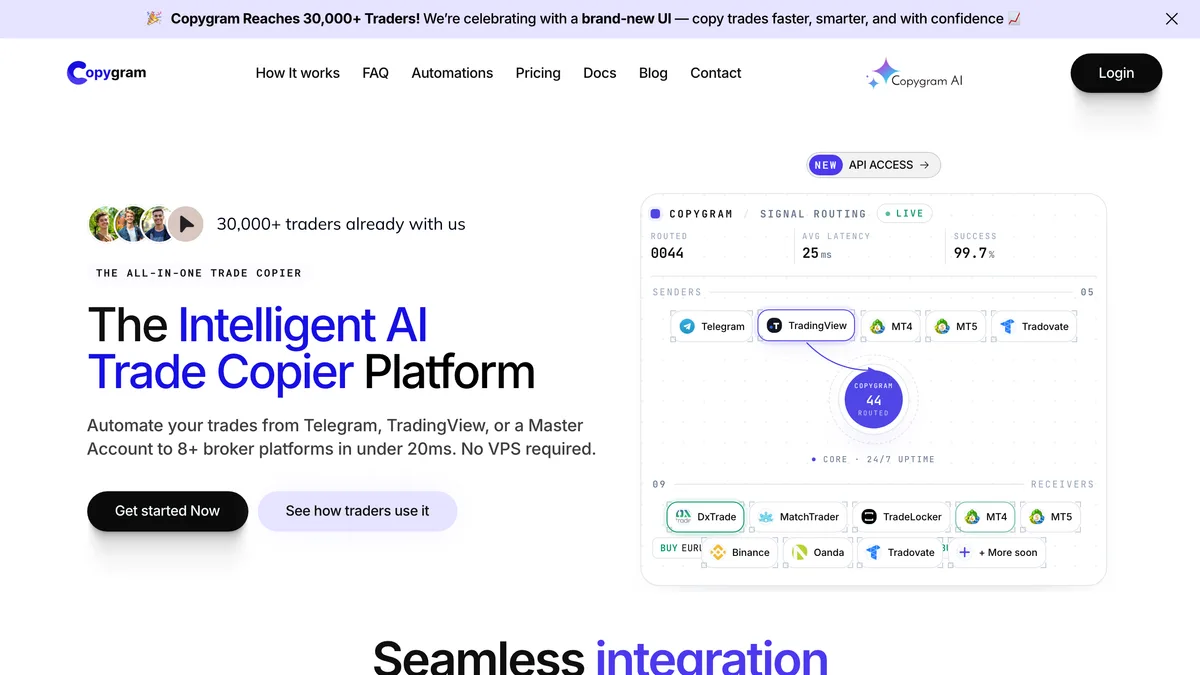
Verdict: A genuinely well-engineered trade copier with the best risk controls in its price band and no performance fee, sold by a company we could not locate on any register, with a 7-day conditional refund window and a track record of execution complaints. Suitable as plumbing for a source you already trust; not a substitute for a vetted copy trading platform. We score it 5.6 / 10.
| Attribute | Value | Source |
|---|---|---|
| Company & track record | Copygram's privacy policy states, verbatim, “Copygram is owned by Finnect LLC.” That is the entirety of the corporate disclosure. There is no address, no jurisdiction, no state of incorporation, and no registration number anywhere on the site, no founder or CEO is named, no founding year is given, and the only contact route is contact@copygram.app. We could not locate Finnect LLC on any public company register. We are not asserting the entity does not exist; we are reporting that we could not find it. Note that copygr.am (Copygram AB, a Swedish photo-printing company) is an entirely unrelated business. | Copygram privacy policy ↗ |
| What it is | A cloud-hosted trade copier and signal router, sold by subscription. Not a broker. Its own FAQ defines the category: “A trade copier is a software tool that automatically replicates trading orders from a source (like a Telegram channel, TradingView alert, or a master trading account) to one or multiple destination accounts.” It holds no client funds; your capital stays at your own broker or prop firm, and Copygram transmits order instructions only. That is architecturally accurate. | Copygram ↗ |
| Regulation & fund custody | Copygram claims no licence and names no regulator anywhere on its site, and we found no FCA, CySEC, ASIC, SEC, or NFA warning naming Copygram or Finnect LLC. For software that never holds client money, being unregulated is normal and expected, and we do not mark it down as though it were an offshore broker. Custody risk is zero: funds stay with your broker, under that broker's segregation and compensation arrangements. The corollary is just as real, though: no compensation scheme, no ombudsman, and no regulatory recourse against Copygram itself. Your only practical remedy if the software misfires is a card or Stripe chargeback inside a 7-day window. | Copygram ↗ |
| Strategy providers & leaderboard | There is none, and that is the finding. No public leaderboard, no vetted provider marketplace, no verified-return display, and no provider directory exists on copygram.app or platform.copygram.app. Anyone can become a signal provider by creating a private or invite-link “Room,” and Copygram verifies no track record. Its guidance to would-be providers is purely advisory: “Maintain verified results, ideally using accounts monitored by reputable platforms.” There is no past-performance disclaimer on the site because Copygram publishes no returns to disclaim. Read generously, it cannot sell you a demo-fed leaderboard or hide drawdown. Read honestly, the vetting burden is simply relocated onto you. | Copygram platform ↗ |
| Copy mechanics & sizing | Sizing can be fixed lot, risk-based percentage (risk per trade divided by stop-loss multiplied by pip value; the site's worked example is 2% risk on a $10,000 account with a 50-pip stop producing 0.40 lots), equity-based scaling (e.g. 0.01 lot per $1,000 of equity), a multiplier, or a lot-per-1,000-units rule. Modes are combinable per destination account. No “mirror” mode is named. Copy slippage between master and follower is not disclosed anywhere: no latency or fill-difference statistics are published. | Copygram ↗ |
| Risk controls | Account-balance risk, percentage risk, stop-loss management, the option to copy or ignore the source's SL/TP, daily drawdown limits, symbol-specific lot exceptions, forced trade closure at set drawdown levels, override of the master's SL/TP including trailing stops, selective symbol copying, execution time windows, and an “AI Trade Validation with confidence scoring” filter. Hosting is cloud-based with automated failover, so no VPS and no always-on PC. A one-click “close all” kill switch is NOT documented and we could not verify one; Copygram documents only that you can “Start, stop, or adjust copier sessions from anywhere in the world via Copygram's cloud dashboard.” | Copygram ↗ |
| Platforms & integrations | Live signal sources are Telegram, TradingView (webhook), MT4, MT5, and Tradovate. Live destinations are MT4, MT5, DXTrade, TradeLocker, MatchTrader, Binance Futures, Oanda, and Tradovate. Discord is labelled “(soon)” on the site and is roadmap, not shipped. Assets covered are forex and CFDs, futures, and crypto; there are no stocks or equities. There is no live mobile app on either the iOS App Store or Google Play as of July 2026 (the Play listing 404s and the Apple developer page lists no live apps), so this is a web dashboard product. | Copygram ↗ |
| Cost stack & refunds | Copygram itself charges no spread, no commission, no performance fee, no profit share, and applies no high-water mark; it is subscription-only. Your real all-in cost is the Copygram subscription plus your own broker's spreads and commissions on every copied trade plus whatever the signal provider privately charges you, which providers set ad hoc (“recurring subscriptions, profit-sharing, or flat-rate packages”) entirely outside the platform. So the site's claim that “All prices are all-inclusive with no hidden third-party fees” is true of Copygram's own bill and says nothing about your provider's. Refunds are first-time subscribers only, within 7 calendar days, and “issued upon demonstration that Copygram is non-functional”; after that, “no refunds will be issued for any reason.” Renewals and upgrades are ineligible, and there is no refund where “a broker or prop firm disabling the API” of DXTrade, MatchTrader, or TradeLocker. | Copygram refund policy ↗ |
| Prop-firm positioning | Copygram markets to prop traders hard. Its FAQ says it is “highly optimized for prop firm traders using TopStep, Apex Trader Funding, FTMO, and others,” and it publishes challenge-passing content, but we found no warning anywhere on its site about prop-firm copy-trading rules, while its refund policy pre-emptively refuses refunds if a prop firm disables API access. Firms generally distinguish copying your own accounts (usually permitted) from copying an external signal provider (generally not), and cloud copiers route from shared infrastructure that correlated-account detection can flag. FTMO's Forbidden Trading Practices page states you “must not allow any third party to access or otherwise use your FTMO Account.” We assert no specific firm's outright ban; read your own firm's rules before connecting anything. | FTMO forbidden trading practices ↗ |
| Security & connection | Accounts are added “using your broker credentials” via a “secure API connection.” Whether that means an order-placing password or a read-only investor password is not disclosed on the public site, and the help article that should answer it returned HTTP 500 when we tried to read it. Structurally, a MetaTrader investor password is read-only and cannot place orders, so any destination account must be connected with credentials capable of placing orders; that is a consequence of how MetaTrader works, not a Copygram disclosure. The fact that we have to reason it out rather than read it is itself the problem. | Copygram ↗ |
| Vendor claims | Copygram advertises “30,000+ traders already with us,” “under 20ms” end-to-end execution, and “100% Cloud-Based (No VPS).” All are its own unaudited figures with nothing independent behind them, and there is no advertised return figure of any kind. The irony is hard to miss: the single loudest independent complaint theme is execution fidelity, and Copygram publishes no slippage or latency data that would substantiate the 20ms claim or rebut the complaints. | Copygram ↗ |
| Platform | Score | Sample | Source |
|---|---|---|---|
| Trustpilot (profile returned HTTP 403; figure hedged, not confirmed) | ~3.9 / 5 | ~80-90 reviews | Source ↗ |
| Community sentiment (Forex Peace Army, aggregated reviews, YouTube) | Mixed to negative | Recurring themes: missed/delayed signals, phantom duplicates, support non-response; positives on setup ease and no-VPS cloud hosting. No Reddit, Product Hunt, or MQL5 footprint at all | Source ↗ |
| Aggregate | ~3.9 / 5 (hedged) | Roughly 80-90 Trustpilot reviews; page would not load directly, and no app-store rating exists | Normalized by TheFXGeek |
“Refunds are issued upon demonstration that Copygram is non-functional. After the 7-day period, no refunds will be issued for any reason.”
Copygram Terms of Service, Refund Policy, accessed July 2026 TOS ↗
Flat monthly subscription ($29 / $49 / $79, or $14 / $24 / $39 billed yearly). Copygram charges no spread, no commission, no profit share, and applies no high-water mark. Real all-in cost = subscription + your own broker's spreads and commissions + whatever your signal provider privately charges you off-platform.“I stumbled upon this software that connects Telegram trades to MT5, and wow, it's a game-changer!”
Vishal Mishra, realreviews.io (aggregator), Feb 2026 source ↗
“The system is supposed to sync trades, but it ended up costing me $2500 in just one day.”
Paul, realreviews.io (aggregator), Dec 2025 source ↗
- Holds no client money; funds stay at your own broker, so no custody, segregation, or withdrawal risk with Copygram itself
- No performance fee, no profit share, and no high-water mark, unlike most hosted copy platforms
- Five combinable sizing modes: fixed lot, risk-based percentage, equity scaling, multiplier, and lot per 1,000 units
- Deep risk layer: daily drawdown limits, forced closure at set drawdown levels, SL/TP override with trailing stops, symbol-specific exceptions, execution time windows
- Broad shipped integrations: Telegram, TradingView, MT4, MT5, Tradovate as sources; MT4, MT5, DXTrade, TradeLocker, MatchTrader, Binance Futures, Oanda, Tradovate as destinations
- Cloud-hosted with automated failover, so no VPS and no always-on PC
- Flat, legible pricing with unlimited rooms and unlimited trade executions on every tier
- Cancellation is self-serve through the Stripe billing portal
- No provider vetting of any kind: no leaderboard, no verified track records, no drawdown data, so you grant order-placing rights over a live account to an unvetted, often anonymous Telegram channel
- Execution fidelity is the dominant independent complaint theme (missed and delayed signals, phantom duplicates, orphan positions, unrequested trades), with no published slippage or latency data to rebut it
- Operator “Finnect LLC” could not be located on any public company register; the site publishes no address, jurisdiction, governing law, or risk disclosure
- Refunds are 7 days, first-time subscribers only, and conditional on demonstrating the product is “non-functional”; there is no free trial
- No documented one-click kill switch, and support non-response is a recurring complaint

Verdict: A capable, free, broadly integrated copy network whose leaderboard the operator itself classifies as hypothetical demo data. Usable as a discovery tool by experienced traders with strict allocation limits; a serious risk to any beginner who takes the numbers at face value. We score it 4.3 / 10.
| Attribute | Value | Source |
|---|---|---|
| Company & ownership | Founded 2007 in Piraeus, Greece. Acquired by Formax Group in 2017, then by India's Finvasia Group in an acquisition announced 13 December 2021 covering both ZuluTrade Group and the AAAFx brokerage. Finvasia is the current owner. The site footer describes the trademark holder as “ZuluTrade International Limited, a software development company registered in Cyprus under Registration No HE242240.” That word, software, is the important one: ZuluTrade is not a broker, it is a layer that sits between you and one. | ZuluTrade ↗ |
| Regulation & fund custody | ZuluTrade holds no client money. Its own reply to a Trustpilot reviewer reads: “ZuluTrade is a social trading platform, no deposit, nor withdrawal takes place on our platform. Please contact your broker.” The footer states the service “is regulated by the Hellenic Capital Markets Commission in Greece under License No 2/540/17.2.2010,” but that licence traces to Triple-A Experts Investment Services Single Member S.A. (retail brand AAAFx), the group's broker and a separate legal entity. We paged through all four pages of the HCMC public register of Investment Services Firms and could not locate Triple-A Experts, AAAFx or ZuluTrade on it, and the HCMC company-detail page search engines associate with the firm returns “Item not found.” We report that as a limitation, not an accusation: a listing or naming quirk is plausible, and we have no evidence the licence is fake or withdrawn. Segregation and any compensation scheme depend entirely on the broker you connect. | HCMC register ↗ |
| Provider track records | The decisive fact, and it comes from ZuluTrade itself: “The hypothetical performance results displayed on this website are hypothetical results in that they represent trades made in a demonstration ("demo") account.” The disclaimer adds that demo trades assume “a Leader having access to an unlimited amount of funds,” so those accounts “are not subject to margin calls and have the ability to withstand large, sustained drawdowns which a customer account may not be able to afford,” and “are not subject to price slippage.” Then: “All performance results presented only include the results of completed trades and do not reflect the profit or loss on open positions.” A Leader nursing a catastrophic floating loss can still display a clean, rising equity curve. We could not confirm whether the live leaderboard labels each Leader demo versus live, and we do not claim all or most Leaders trade demo. | ZuluTrade risk disclaimer ↗ |
| Copy mechanics | Proportional position sizing by default, with adjustable lot size per Leader. Two allocation modes: Custom, where you set lots yourself, and Auto, where lots are scaled to a chosen risk level with a cap on maximum open trades. “Combos” spread allocation across several Leaders, and there is no stated ceiling on how many Leaders you can follow. Discovery runs through the proprietary ZuluRank algorithm, a 1-to-5 per-Leader risk score, and more than 40 filters, with drawdown among the filterable metrics. The control surface is genuinely one of the better ones in the category; the problem is what it is pointed at. | ZuluTrade user guide ↗ |
| ZuluGuard risk control | A real kill switch, with a trap in it. On trigger, ZuluGuard closes that Leader's open trades in your account and blocks the Leader from opening new ones. But in Fixed Mode, protection is calculated off your initial capital only and does not protect accumulated profit: ZuluTrade's own worked example says that with $500 of capital protection and a Leader on $2,000 of closed profit, ZuluGuard “will not step in” at minus $500 and “will only be activated at $-2500.” A copier in Fixed Mode can hand back every dollar of profit plus the full buffer. Trailing Mode ratchets protection up with profit and is the mode that actually defends gains. ZuluTrade also warns that in fast markets “there may be substantial losses, as ZuluGuard does not always guarantee the desired Protection.” | ZuluGuard guide ↗ |
| Broker integration | A network, not a broker. Three connection routes per ZuluTrade's own pricing FAQ: Integrated brokers, managed directly inside the ZuluTrade platform; Co-Branded brokers, where you open at a ZuluTrade-branded broker site and connect; and Standard, defined as “Any broker which offers trading accounts on MT4, MT5, ActTrader, XOH.” Supported platforms are MT4, MT5, ActTrader and X Open Hub, all shipped. Only AAAFx, the sister brokerage inside the same group, is confirmed to us as an in-group broker. Markets available through connected brokers span forex, stocks, indices, commodities and crypto. ZuluTrade's own headline scale figures contradict each other badly enough that we publish none of them; the homepage's “2M+ Leaders” is facially absurd. | ZuluTrade pricing FAQ ↗ |
| Credentials required | To copy at all you must hand ZuluTrade your broker master trading password. The user guide is explicit: “Please note that the required password is the MT4, MT5, ActTrader, XOH Master password, and not the Read-Only (Investor) password. If you provide the Read-Only (Investor) password... you will not be able to receive any signals as it will be set to read-only mode.” Read-only credentials cannot place trades, so this is mechanically necessary and we do not treat it as sinister. But it does mean a third party holds keys capable of trading your live account, and for unlisted brokers users are asked to supply the broker's IP address plus username and password too. How ZuluTrade stores those credentials, and who bears liability if they are misused, is not disclosed in its terms. | ZuluTrade user guide ↗ |
| Advertised performance claim | The homepage claims “73% of our investors make profit when copying top leaders correctly,” set against “only 11-26% of manual investors.” No methodology, date range, sample size or footnote appears anywhere on the page. The qualifier “correctly” is an escape hatch: any loss can be attributed to the copier not having copied correctly. We treat it as an unverified advertising claim, not a statistic, and note that past performance, hypothetical or real, does not guarantee future results. | ZuluTrade ↗ |
| Regulatory history | Two matters exist and we report them as history. On 9 September 2014 the CFTC fined Zulutrade Inc., then a registered Introducing Broker, $150,000 plus $80,000 disgorgement for failing to follow its own OFAC sanctions-screening procedures between October 2010 and October 2013, having opened roughly 400 accounts for accountholders in OFAC-targeted countries (primarily Iran, Sudan, Syria). The NFA filed a complaint in April 2016 alleging net-capital, AML and supervision failures; it settled for $30,000 payable only on any reapplication, membership terminated 14 July 2016, and ZuluTrade left the US retail market. Both are ten to twelve years old, concern a now-defunct US entity, and pre-date Finvasia's 2021 ownership and the current fee model. We do not let a 2014 sanctions-screening lapse drive a 2026 score. | CFTC ↗ |
| Platform | Score | Sample | Source |
|---|---|---|---|
| Trustpilot | ~1.5 / 5 | ~110 reviews, “Bad” band, observed July 2026. Direct fetch blocked; cached snapshots ranged 1.3-1.9, so treat as approximate | Source ↗ |
| App Store (iOS) | 4.0 / 5 | Only 12 ratings — far too small a sample to be meaningful, and we do not average it against Trustpilot | Source ↗ |
| Aggregate | ~1.5 / 5 (Trustpilot) | ~110 reviews, approximate; observed July 2026 | Normalized by TheFXGeek |
“Accordingly, the performance of customer accounts may vary significantly from the results portrayed on this website.”
ZuluTrade Terms of Service, Full Disclaimer, accessed July 2026 TOS ↗
No subscription and no investor performance fee since 1 Jan 2023. You pay the connected broker's spread and commission; any ZuluTrade markup inside that spread is not disclosed.“Zulutrade is a great platform for copy trading. I've been a customer for almost two years now and I have no complaints. The withdrawal process is smooth and fast. The deposit as well and they offer several options. The platform is user friendly, allowing rookie traders to get the most of their strategies. I definitely recommend this copy-trading platform.”
Philip Lewis, Trustpilot, Date not shown source ↗
“I started to receive spam emails and scam calls from weird companies regarding my trading experience and they had all my personal details from Zulutrade.”
Hnza75, App Store (iOS) review, Mar 2021 source ↗
- Investors pay ZuluTrade nothing: no subscription and no performance fee since 1 January 2023
- Broad integration across MT4, MT5, ActTrader and XOH, via Integrated, Co-Branded or Standard broker routes
- ZuluGuard closes a Leader's open trades in your account and blocks new ones when triggered
- Proportional sizing by default, with per-Leader lot adjustment and Custom or Auto allocation modes
- More than 40 filters, a 1-to-5 per-Leader risk score, and drawdown available as a filterable metric
- No stated limit on Leaders copied, with “Combos” for multi-Leader allocation
- Free full-functionality demo account created at registration
- The risk disclaimer, wherever it sits, is unusually candid about what the displayed numbers are
- ZuluTrade's own disclaimer states displayed performance is hypothetical demo data and excludes profit or loss on open positions, so a Leader with a large floating loss can still show a clean record
- We could not confirm whether the live leaderboard labels each Leader as demo or live, which is itself a transparency failure
- Not the regulated entity and holds no client money; the footer licence traces to sister broker AAAFx and we could not confirm it on the HCMC register
- Copying requires handing over your broker master trading password; credential storage and liability are not disclosed
- The real cost is an undisclosed markup inside the connected broker's spread
- Stale live subdomains still advertise the abolished $30/month plus 25% performance-fee model
- Trustpilot sits near 1.5 / 5, with persistent themes of copier results diverging from advertised Leader results
What to look for in a copy trading platform
Check Who Holds Your Money and Who Regulates It
Copy trading almost always involves a real money account, so the first question is who custodies your funds and under which regulator. Some platforms are themselves brokers licensed by the FCA, CySEC, or ASIC and hold client money in segregated accounts; others are third-party networks that route to a separate broker who actually holds the funds. Look up the licence on the regulator's own register, confirm the entity matches the one you would deposit with, and treat an unregulated or purely offshore setup as a higher-risk proposition no matter how good the leaderboard looks.
Treat Every Track Record as Unproven Until Verified
The headline returns on a provider leaderboard are the most manipulated numbers in this category. Returns can come from demo accounts, from a few lucky weeks with no real history behind them, or from a board scrubbed of everyone who blew up, which is survivorship bias. Favour platforms that publish independently verified, real-money track records with the full history and the maximum drawdown shown as prominently as the gain. A provider up 400 percent with a hidden 90 percent drawdown is not a star, they are a margin call waiting to happen.
Understand How Copying Is Sized and Controlled
How a platform copies trades decides how much risk you actually take. Proportional copying scales positions to your capital so a small account is not over-exposed, while fixed-lot mirroring can be dangerous. Check the risk controls: can you cap position size, set a stop-loss on the whole copied account, and stop copying or close everything in one action? Also look at copy slippage, since latency and spreads mean your fills rarely match the provider's. The ability to pull out fast is your main defence when a provider turns.
Add Up the Full Cost Stack
Copy trading costs stack in places the marketing rarely totals for you. On top of the spread or commission on every copied trade, many platforms charge a performance fee or profit share to the provider, often 20 to 30 percent and sometimes only above a high-water mark, and some add a platform subscription. A zero-commission badge frequently hides a wider spread. Add it all up against a provider's realistic, not best-case, returns, and remember that past performance does not guarantee future results, so a fee that looks small in a good month still bites in a bad one.
Forex Trading Glossary
Quick definitions for terms used throughout this guide, spreads, pips, leverage, and margin, and how they shape what trading with a given broker actually costs.
- Copy trading
- Automatically mirroring another trader's positions in your own account, sized to the capital you allocate, so their entries and exits are replicated as yours.
- Social trading
- A copy trading platform with a community layer: feeds, leaderboards, and discussion where you can find, follow, and copy other traders.
- Strategy provider
- The trader being copied, also called a signal provider, lead trader, or popular investor. Their results become the basis for everyone copying them.
- Performance fee
- A cut of the profits a copier pays the strategy provider, often 20 to 30 percent, sometimes only above a high-water mark. It is on top of spreads and commissions.
- High-water mark
- The peak account value a provider has reached, used so performance fees are only charged on new profits above the previous high, not on recovering past losses.
- Proportional copying
- Sizing copied trades in proportion to your allocated capital versus the provider's, rather than mirroring their exact lot size, so a small account is not over-exposed.
- Copy slippage
- The price difference between when the provider's trade fills and when your copy fills. Latency, spreads, and order routing mean your result rarely matches the provider's exactly.
- Drawdown
- The peak-to-trough fall in an account's value. A provider's maximum historical drawdown is a better risk gauge than their headline return, and is often shown far less prominently.
- Survivorship bias
- A leaderboard distortion where failed or blown-up providers disappear, leaving only winners on display and making the platform's typical results look far better than they are.
- Demo vs live track record
- Whether a provider's published stats come from a real-money account or a risk-free demo. Demo records ignore real fills, slippage, and psychology, and can wildly overstate a strategy.
- PAMM / MAM
- Percentage Allocation Money Management and Multi-Account Manager: structures where a manager trades a pooled or linked set of accounts, closer to a managed account than to reversible copy trading.
- Segregated funds
- Client money held separately from the platform's or broker's own funds, so it is protected if the firm becomes insolvent. A key fund-safety check before depositing.
How we rank
Every copy trading platform is scored from 1 to 10 across six weighted axes: copy performance and transparency, platform and broker integration, copy controls and risk management, cost and value, regulation and fund safety, and support and reputation. We confirm who holds client funds and on which regulator's register, check whether provider track records are independently verified or self-reported, verify how copying is sized and controlled, and lay out the spreads, commissions, and performance fees in full. We treat every advertised return as past performance that does not guarantee future results. Scores are reviewed as fees, providers, and regulation change, and affiliate relationships never influence a ranking or a position in this list.
Frequently asked questions
A deep, genuinely capable desktop trade copier at $199 one-time, sold on a Reverse Mode claim that does not survive basic arithmetic and backed by paperwork that contradicts both the product's own architecture and its own refund promise. Open a demo to try it risk-free, then fund a live account when you're ready. Trading carries risk.
Try Forex Copier