
What is Copygram?
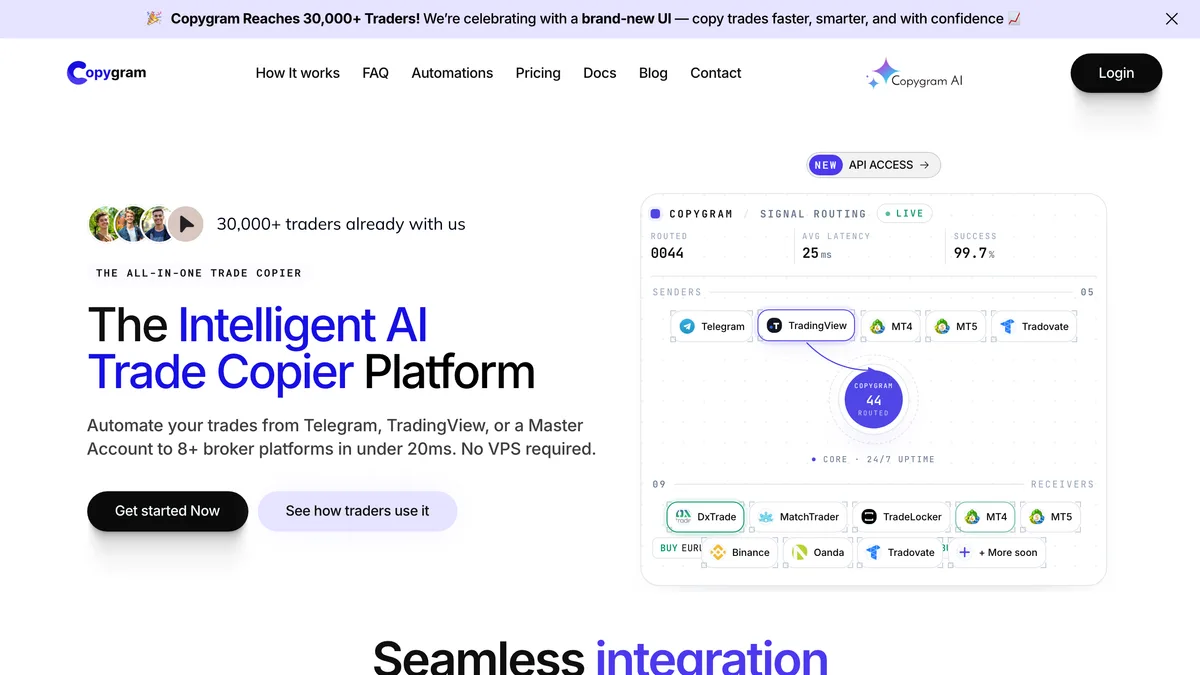
Copygram is a cloud-hosted trade copier, sold by subscription, operated by an entity the privacy policy names as “Finnect LLC.” Its own FAQ defines the category plainly: “A trade copier is a software tool that automatically replicates trading orders from a source (like a Telegram channel, TradingView alert, or a master trading account) to one or multiple destination accounts.” That is architecturally accurate, and it matters. Copygram is not a broker. It holds no client funds. Your capital sits where it already sits, at your broker or prop firm, under whatever custody and segregation regime that firm operates. The entire class of risk that dominates hosted copy platforms, the risk that a lightly regulated operator is holding your deposit and might make withdrawals difficult, simply does not exist here.
What replaces it are two different risks, and they are not small. The first is execution: software that routes live orders into a live account has to work, every time, and the dominant independent complaint theme about Copygram is that sometimes it does not. The second is vetting: because Copygram publishes no provider data and verifies no track record, the person whose orders land in your account is whoever you decided to trust, usually an anonymous Telegram channel, with no platform check of any kind standing between them and your balance.
Live signal sources are Telegram, TradingView via webhook, MT4, MT5, and Tradovate. Live destinations are MT4, MT5, DXTrade, TradeLocker, MatchTrader, Binance Futures, Oanda, and Tradovate. Discord is listed as “(soon)” and is therefore roadmap, not a shipped feature, so do not buy on the strength of it. Assets covered are forex and CFDs, futures, and crypto. There are no stocks. There is no live mobile app on either the iOS App Store or Google Play as of July 2026, so this is a web dashboard product.
Our verdict
Copygram earns a 5.6 out of 10 from us, and the number is a genuine average of extremes rather than a shrug. On copy mechanics it is one of the better-specified copiers we have looked at. On cost it is honest by the standards of the category: no spread, no commission, no performance fee, no profit share, no high-water mark, just a flat subscription. On regulation it is unregulated, which for order-routing software that never holds money is normal and expected, not damning.
What drags it down is governance and evidence. The operator cannot be found on any public company register. The site publishes no address, no jurisdiction, no governing law, and no risk disclosure. The refund policy gives you seven days, first-time subscribers only, and asks you to demonstrate the product is non-functional. The recurring independent complaint is that the software's core job, copying trades accurately, is the thing users say fails, and support goes quiet. For a vendor claiming 30,000 or more traders, the near-total absence of an organic community footprint is itself an evidence problem.
We assess Copygram from its public pages, pricing, terms, refund and privacy policies, its logged-out dashboard surface, and a search for company-register records, regulator warnings, app-store listings, and independent user sentiment. We have not purchased a subscription or copied a trade.
Key features & specs
The specification sheet is where Copygram is at its strongest, and it is worth reading as a risk-engineering tool rather than a copy-trading product. The sizing engine is unusually rich for the price: fixed lot, risk-based percentage, equity scaling, a multiplier, and a lot-per-1,000-units rule, all combinable per destination account. The risk layer goes well beyond the on/off switch most copiers ship with, covering daily drawdown limits, forced closure at set drawdown levels, SL/TP override including trailing stops, symbol-specific exceptions, execution time windows, and an “AI Trade Validation” confidence filter. Cloud hosting with automated failover removes the VPS chore that makes MetaTrader copying miserable. What the sheet does not contain is any provider data, any published latency or slippage evidence, or any documented one-click kill switch, and those absences are the story as much as the features are. Discord is roadmap, not shipped, and there is no live mobile app.
| Attribute | Value | Source |
|---|---|---|
| Company & track record | Copygram's privacy policy states, verbatim, “Copygram is owned by Finnect LLC.” That is the entirety of the corporate disclosure. There is no address, no jurisdiction, no state of incorporation, and no registration number anywhere on the site, no founder or CEO is named, no founding year is given, and the only contact route is contact@copygram.app. We could not locate Finnect LLC on any public company register. We are not asserting the entity does not exist; we are reporting that we could not find it. Note that copygr.am (Copygram AB, a Swedish photo-printing company) is an entirely unrelated business. | Copygram privacy policy ↗ |
| What it is | A cloud-hosted trade copier and signal router, sold by subscription. Not a broker. Its own FAQ defines the category: “A trade copier is a software tool that automatically replicates trading orders from a source (like a Telegram channel, TradingView alert, or a master trading account) to one or multiple destination accounts.” It holds no client funds; your capital stays at your own broker or prop firm, and Copygram transmits order instructions only. That is architecturally accurate. | Copygram ↗ |
| Regulation & fund custody | Copygram claims no licence and names no regulator anywhere on its site, and we found no FCA, CySEC, ASIC, SEC, or NFA warning naming Copygram or Finnect LLC. For software that never holds client money, being unregulated is normal and expected, and we do not mark it down as though it were an offshore broker. Custody risk is zero: funds stay with your broker, under that broker's segregation and compensation arrangements. The corollary is just as real, though: no compensation scheme, no ombudsman, and no regulatory recourse against Copygram itself. Your only practical remedy if the software misfires is a card or Stripe chargeback inside a 7-day window. | Copygram ↗ |
| Strategy providers & leaderboard | There is none, and that is the finding. No public leaderboard, no vetted provider marketplace, no verified-return display, and no provider directory exists on copygram.app or platform.copygram.app. Anyone can become a signal provider by creating a private or invite-link “Room,” and Copygram verifies no track record. Its guidance to would-be providers is purely advisory: “Maintain verified results, ideally using accounts monitored by reputable platforms.” There is no past-performance disclaimer on the site because Copygram publishes no returns to disclaim. Read generously, it cannot sell you a demo-fed leaderboard or hide drawdown. Read honestly, the vetting burden is simply relocated onto you. | Copygram platform ↗ |
| Copy mechanics & sizing | Sizing can be fixed lot, risk-based percentage (risk per trade divided by stop-loss multiplied by pip value; the site's worked example is 2% risk on a $10,000 account with a 50-pip stop producing 0.40 lots), equity-based scaling (e.g. 0.01 lot per $1,000 of equity), a multiplier, or a lot-per-1,000-units rule. Modes are combinable per destination account. No “mirror” mode is named. Copy slippage between master and follower is not disclosed anywhere: no latency or fill-difference statistics are published. | Copygram ↗ |
| Risk controls | Account-balance risk, percentage risk, stop-loss management, the option to copy or ignore the source's SL/TP, daily drawdown limits, symbol-specific lot exceptions, forced trade closure at set drawdown levels, override of the master's SL/TP including trailing stops, selective symbol copying, execution time windows, and an “AI Trade Validation with confidence scoring” filter. Hosting is cloud-based with automated failover, so no VPS and no always-on PC. A one-click “close all” kill switch is NOT documented and we could not verify one; Copygram documents only that you can “Start, stop, or adjust copier sessions from anywhere in the world via Copygram's cloud dashboard.” | Copygram ↗ |
| Platforms & integrations | Live signal sources are Telegram, TradingView (webhook), MT4, MT5, and Tradovate. Live destinations are MT4, MT5, DXTrade, TradeLocker, MatchTrader, Binance Futures, Oanda, and Tradovate. Discord is labelled “(soon)” on the site and is roadmap, not shipped. Assets covered are forex and CFDs, futures, and crypto; there are no stocks or equities. There is no live mobile app on either the iOS App Store or Google Play as of July 2026 (the Play listing 404s and the Apple developer page lists no live apps), so this is a web dashboard product. | Copygram ↗ |
| Cost stack & refunds | Copygram itself charges no spread, no commission, no performance fee, no profit share, and applies no high-water mark; it is subscription-only. Your real all-in cost is the Copygram subscription plus your own broker's spreads and commissions on every copied trade plus whatever the signal provider privately charges you, which providers set ad hoc (“recurring subscriptions, profit-sharing, or flat-rate packages”) entirely outside the platform. So the site's claim that “All prices are all-inclusive with no hidden third-party fees” is true of Copygram's own bill and says nothing about your provider's. Refunds are first-time subscribers only, within 7 calendar days, and “issued upon demonstration that Copygram is non-functional”; after that, “no refunds will be issued for any reason.” Renewals and upgrades are ineligible, and there is no refund where “a broker or prop firm disabling the API” of DXTrade, MatchTrader, or TradeLocker. | Copygram refund policy ↗ |
| Prop-firm positioning | Copygram markets to prop traders hard. Its FAQ says it is “highly optimized for prop firm traders using TopStep, Apex Trader Funding, FTMO, and others,” and it publishes challenge-passing content, but we found no warning anywhere on its site about prop-firm copy-trading rules, while its refund policy pre-emptively refuses refunds if a prop firm disables API access. Firms generally distinguish copying your own accounts (usually permitted) from copying an external signal provider (generally not), and cloud copiers route from shared infrastructure that correlated-account detection can flag. FTMO's Forbidden Trading Practices page states you “must not allow any third party to access or otherwise use your FTMO Account.” We assert no specific firm's outright ban; read your own firm's rules before connecting anything. | FTMO forbidden trading practices ↗ |
| Security & connection | Accounts are added “using your broker credentials” via a “secure API connection.” Whether that means an order-placing password or a read-only investor password is not disclosed on the public site, and the help article that should answer it returned HTTP 500 when we tried to read it. Structurally, a MetaTrader investor password is read-only and cannot place orders, so any destination account must be connected with credentials capable of placing orders; that is a consequence of how MetaTrader works, not a Copygram disclosure. The fact that we have to reason it out rather than read it is itself the problem. | Copygram ↗ |
| Vendor claims | Copygram advertises “30,000+ traders already with us,” “under 20ms” end-to-end execution, and “100% Cloud-Based (No VPS).” All are its own unaudited figures with nothing independent behind them, and there is no advertised return figure of any kind. The irony is hard to miss: the single loudest independent complaint theme is execution fidelity, and Copygram publishes no slippage or latency data that would substantiate the 20ms claim or rebut the complaints. | Copygram ↗ |
Pricing & value
Three tiers, billed monthly or annually. Starter is $29 a month, or $14 a month billed yearly, and covers up to 2 trading accounts and 1 webhook. Pro, badged “Most Popular,” is $49 a month, or $24 a month billed yearly, and covers up to 3 trading accounts, 2 webhooks, and unlimited Telegram channels. Advanced is $79 a month, or $39 a month billed yearly, for up to 5 trading accounts and 3 webhooks. Note carefully what the cap actually is: it is on connected trading accounts, not on providers. Rooms are unlimited on every tier, as are trade executions, live chart trading, advanced trade logs, premium support, AI Trade Validation, and alerts. There is no free trial advertised on the pricing page, which for a product whose main complaint theme is “it did not copy my trades” is a meaningful gap. You pay first and find out afterwards, with a refund window of seven days.
Now the all-in stack, because the subscription is not the whole cost. Your real spend is the Copygram subscription, plus your own broker's spreads and commissions on every copied trade, plus whatever the individual signal provider privately charges you. Copygram itself takes nothing from your P&L. There is genuinely no performance fee, no profit share, and no high-water mark, and against a hosted platform that skims 10 to 20 percent of your gains that is a real, quantifiable advantage. But be clear-eyed: the provider fee has not been abolished, it has been moved off-platform and out of sight. Copygram's own material acknowledges providers may set “recurring subscriptions, profit-sharing, or flat-rate packages” ad hoc, entirely outside its system. So the site's claim that “All prices are all-inclusive with no hidden third-party fees” is true of Copygram's own bill and says nothing at all about what your Telegram channel charges you, or how it collects it, or what recourse you have if it stops posting.
Refunds are tight and worth quoting before you subscribe rather than after. “Refunds are only available to first-time subscribers of Copygram.” The request “must be made within 7 calendar days of the initial purchase date.” “Refunds are issued upon demonstration that Copygram is non-functional.” “After the 7-day period, no refunds will be issued for any reason.” There is no refund where “a broker or prop firm disabling the API” of DXTrade, MatchTrader, or TradeLocker. Cancellations take effect at the end of the current billing cycle, with no proration, and renewals and upgrades are ineligible. Cancellation itself is self-serve through the Stripe billing portal, which is the one clean part of the arrangement.
Flat monthly subscription ($29 / $49 / $79, or $14 / $24 / $39 billed yearly). Copygram charges no spread, no commission, no profit share, and applies no high-water mark. Real all-in cost = subscription + your own broker's spreads and commissions + whatever your signal provider privately charges you off-platform.| Plan | Min to copy | Trading cost | Performance fee | Best for |
|---|---|---|---|---|
| Starter | No deposit to Copygram; broker minimum applies | Spread only (charged by your own broker) | No performance fee ($29/mo, or $14/mo billed yearly) | One or two accounts, a single webhook, first-time copier users |
| Pro (Most Popular) | No deposit to Copygram; broker minimum applies | Spread only (charged by your own broker) | No performance fee ($49/mo, or $24/mo billed yearly) | Up to 3 accounts, 2 webhooks, and unlimited Telegram channels |
| Advanced | No deposit to Copygram; broker minimum applies | Spread only (charged by your own broker) | No performance fee ($79/mo, or $39/mo billed yearly) | Up to 5 accounts and 3 webhooks; multi-account and prop-style setups |
Regulation & fund safety
This is the section that decides the review, and it splits cleanly in two. On providers, there is nothing to assess, and that is the finding. Copygram publishes no leaderboard, operates no vetted marketplace, displays no verified returns, and maintains no provider directory on either copygram.app or platform.copygram.app. Anyone can become a signal provider by creating a private or invite-link “Room.” Copygram verifies no track record. Its guidance to would-be providers is purely advisory: “Maintain verified results, ideally using accounts monitored by reputable platforms.” There is no past-performance disclaimer on the site, and there does not need to be, because there is no performance claim to disclaim.
Read that generously and it is a virtue. Copygram cannot sell you a demo-account leaderboard dressed as live results, cannot hide drawdown, and cannot practise survivorship bias by quietly deleting the providers who blew up, because it never showed you any of them in the first place. There is no fabricated 300 percent hero card here. Read it honestly and the danger is just relocated onto you. You are granting order-placing rights over a live account to an anonymous channel that no one has checked, whose real drawdown you have never seen, and whose history you cannot audit. On a hosted platform with a bad leaderboard, at least the numbers are theoretically falsifiable. Here, there are no numbers at all.
The mechanics, by contrast, are legitimately good, and two caveats sit under them. First, we could not verify a one-click kill switch or close-all button; Copygram documents only that you can “Start, stop, or adjust copier sessions from anywhere in the world via Copygram's cloud dashboard,” which is not the same thing as a documented emergency flatten. Second, copy slippage between master and follower is not disclosed anywhere, and no latency or fill-difference statistics are published. The vendor claims “under 20ms” end-to-end execution, unaudited, and the irony is hard to miss: the single loudest independent complaint theme is execution fidelity. Delays, missed signals, phantom duplicates, orphan positions, and unrequested trades all appear in user reports, and Copygram publishes nothing that either confirms or rebuts them.
On regulation, Copygram claims no licence and names no regulator, and we found no FCA, CySEC, ASIC, SEC, or NFA warning naming Copygram or Finnect LLC. For software that never holds client money, being unregulated is normal and expected, and we do not mark it down as though it were an offshore broker. Custody risk here is zero: your funds stay with your broker, under your broker's segregation, negative-balance protection, and compensation arrangements, not Copygram's. The corollary needs saying just as plainly. Unregulated means no compensation scheme, no ombudsman, and no regulatory recourse against Copygram itself. If the software misfires and costs you money, your only practical remedy is a card or Stripe chargeback, inside a seven-day window, on a refund policy that requires you to demonstrate the product is “non-functional.” Custody risk sits with your broker; execution and software risk sit with an unregulated vendor you cannot easily identify.
And you genuinely cannot easily identify it. The privacy policy says, verbatim, “Copygram is owned by Finnect LLC.” That is the entirety of the corporate disclosure. There is no address, no jurisdiction, no state of incorporation, and no registration number anywhere on the site, and the only contact route is an email address. We could not locate Finnect LLC on any public company register. We are not asserting the entity does not exist; we are reporting that we could not find it, and that a paying customer should not have to. The Terms of Service, last updated 4 July 2024, do nothing to fill the gap. They cover refunds, cancellation, and disputes only. There is no risk disclosure, no limitation of liability, and no governing-law clause, which means the document that is supposed to tell you which courts hear a dispute does not tell you.
“Refunds are issued upon demonstration that Copygram is non-functional. After the 7-day period, no refunds will be issued for any reason.”
Copygram Terms of Service, Refund Policy, accessed July 2026 TOS ↗
On the leaderboard-honesty axis, Copygram is clean by omission: it advertises no returns, so it inflates none. On cost disclosure it is largely clean too, with plain tier pricing and no platform performance fee. Where the disclosure fails is everywhere else. Security is the sharpest example. Accounts are added “using your broker credentials” via a “secure API connection,” but whether that means an order-placing password or a read-only investor password is not disclosed on the public site, and the help article that should answer it returned HTTP 500 when we tried to read it. Structurally, a MetaTrader investor password is read-only and cannot place orders, so any destination account must be connected with credentials capable of placing orders. That is a consequence of how MetaTrader works, not a Copygram disclosure, and the fact that we have to reason it out rather than read it is precisely the problem.
Prop-firm traders need one more warning, because Copygram markets to them hard. Its FAQ says it is “highly optimized for prop firm traders using TopStep, Apex Trader Funding, FTMO, and others,” it publishes challenge-passing content, and we found no warning anywhere on its site about prop-firm copy-trading rules. Its refund policy meanwhile pre-emptively refuses refunds if “a broker or prop firm disabling the API” of DXTrade, MatchTrader, or TradeLocker. Prop firms broadly distinguish copying your own accounts, usually fine, from copying an external signal provider, generally not, and cloud copiers route from shared infrastructure that correlated-account detection can flag. FTMO's Forbidden Trading Practices page states: “You must not allow any third party to access or otherwise use your FTMO Account.” We are not asserting that any specific firm bans this outright. We are telling you to read your own firm's rules before you connect anything, because Copygram will not read them for you.
What traders say
The sentiment picture is thin, and the thinness is itself a finding. Copygram's Trustpilot profile exists but would not load directly for us (HTTP 403); ratings hover around 3.9 out of 5 from roughly 80 to 90 reviews, and we publish that with the hedge rather than as a confirmed number. There are no app-store ratings, because there is no live app. Forex Peace Army carries a review page whose exact score we could not load.
What is striking is the silence elsewhere. For a product advertising “30,000+ traders already with us,” the organic footprint is close to nonexistent: no r/Forex or r/algotrading threads, no Product Hunt page, no MQL5 listing, no independent user community anywhere. Independent YouTube coverage exists and skews skeptical in framing. A genuine 30,000-user tool that automates live order execution would normally generate arguments, tutorials, bug threads, and workarounds. The absence of all of it is a reason to treat the headcount claim as marketing, not evidence, and to be alert to review skew and affiliate pumping in whatever coverage does exist.
The positives that recur are consistent and believable: setup is easy, it is cloud-based, and you do not need a VPS or an always-on PC. The negatives are more serious, and they cluster on the one thing the product must get right. Missed and delayed signals, phantom duplicates, orphan positions, unrequested trades, non-responsive support, and refused refunds are the recurring themes. Forex Peace Army carries a corroborated complaint from a buyer using MT4 to MatchTrader copying who reported it simply would not copy trades and that support then went silent. We cannot adjudicate individual cases, and a copier will always attract users blaming software for a bad signal provider. But when the loudest complaint about an execution tool is execution, and the vendor publishes no slippage or latency data to rebut it, the burden of proof has not been met.
| Platform | Score | Sample | Source |
|---|---|---|---|
| Trustpilot (profile returned HTTP 403; figure hedged, not confirmed) | ~3.9 / 5 | ~80-90 reviews | Source ↗ |
| Community sentiment (Forex Peace Army, aggregated reviews, YouTube) | Mixed to negative | Recurring themes: missed/delayed signals, phantom duplicates, support non-response; positives on setup ease and no-VPS cloud hosting. No Reddit, Product Hunt, or MQL5 footprint at all | Source ↗ |
| Aggregate | ~3.9 / 5 (hedged) | Roughly 80-90 Trustpilot reviews; page would not load directly, and no app-store rating exists | Normalized by TheFXGeek |
“I stumbled upon this software that connects Telegram trades to MT5, and wow, it's a game-changer!”
Vishal Mishra, realreviews.io (aggregator), Feb 2026 source ↗
“The system is supposed to sync trades, but it ended up costing me $2500 in just one day.”
Paul, realreviews.io (aggregator), Dec 2025 source ↗
Pros & cons
The balance here is unusual: the engineering is better than the governance, and the absence of a leaderboard is simultaneously the best and the most dangerous thing about the product.
- Holds no client money; funds stay at your own broker, so no custody, segregation, or withdrawal risk with Copygram itself
- No performance fee, no profit share, and no high-water mark, unlike most hosted copy platforms
- Five combinable sizing modes: fixed lot, risk-based percentage, equity scaling, multiplier, and lot per 1,000 units
- Deep risk layer: daily drawdown limits, forced closure at set drawdown levels, SL/TP override with trailing stops, symbol-specific exceptions, execution time windows
- Broad shipped integrations: Telegram, TradingView, MT4, MT5, Tradovate as sources; MT4, MT5, DXTrade, TradeLocker, MatchTrader, Binance Futures, Oanda, Tradovate as destinations
- Cloud-hosted with automated failover, so no VPS and no always-on PC
- Flat, legible pricing with unlimited rooms and unlimited trade executions on every tier
- Cancellation is self-serve through the Stripe billing portal
- No provider vetting of any kind: no leaderboard, no verified track records, no drawdown data, so you grant order-placing rights over a live account to an unvetted, often anonymous Telegram channel
- Execution fidelity is the dominant independent complaint theme (missed and delayed signals, phantom duplicates, orphan positions, unrequested trades), with no published slippage or latency data to rebut it
- Operator “Finnect LLC” could not be located on any public company register; the site publishes no address, jurisdiction, governing law, or risk disclosure
- Refunds are 7 days, first-time subscribers only, and conditional on demonstrating the product is “non-functional”; there is no free trial
- No documented one-click kill switch, and support non-response is a recurring complaint
Copygram vs alternatives
Compare Copygram to a hosted copy platform such as eToro or ZuluTrade and you are not comparing like with like. Those platforms give you a provider leaderboard with published statistics, a regulated broker holding your money in segregated accounts, and a compensation scheme behind it, and they charge for that either through wider spreads or a performance fee or both. Their weakness is the leaderboard itself: headline returns are the genre's biggest trap, and demo-fed, survivorship-biased boards have burned copiers repeatedly. Copygram cannot burn you that way, because it shows you nothing. But it also gives you no regulator, no ombudsman, no compensation scheme, and no vetting, and its refund window is a week.
Against other trade copiers, the comparison is cleaner and Copygram fares better. Local MetaTrader copier EAs are cheaper but demand a VPS and an always-on machine, and rarely offer this range of sizing and drawdown controls. Cloud copiers with a comparable integration list generally cost in the same range. The differentiators in Copygram's favour are the risk engineering, the breadth of shipped destinations, and the flat no-performance-fee pricing. The differentiators against it are governance and evidence: a competitor that names its company, publishes a jurisdiction, states a governing law, offers a trial, and publishes latency data is offering something Copygram currently does not, and in a tool that places live orders in a live account, that is not paperwork. It is the product.
How Copygram compares to the next tools in our copy trading platforms ranking:
| Metric | Copygram | Forex Copier | ZuluTrade |
|---|---|---|---|
| Our score | 5.6/10 | 5.9/10 | 4.3/10 |
| Starting price | From $14/mo billed yearly; $29/$49/$79 monthly. No free trial | $199 one-time (Forex Copier 4); Remote 2 from $299. 30-day trial | Free to investors (no subscription, no performance fee); you pay the connected broker's spread, markup undisclosed |
| Best for | Traders who already trust a signal source and want a serious sizing and risk-control engine, not a vetted trader marketplace | Traders self-copying several MT4/MT5/cTrader accounts on one Windows VPS who want deep risk controls for a one-time fee | Experienced traders who already have a trusted MT4/MT5 broker and want a free, flexible copy layer on top of it |
| Regulation | Offshore | Offshore | Offshore |
| Full review | This page | Forex Copier review → | ZuluTrade review → |
In short: Forex Copier edges ahead of Copygram in the overall ranking, but traders who already trust a signal source and want a serious sizing and risk-control engine, not a vetted trader marketplace is where Copygram makes its strongest case.
Who is Copygram for?
Use Copygram if…
Use Copygram if you already have a signal source you trust independently, you understand you are the only vetting layer, and what you actually want is a sizing and risk-control engine that sits between that source and your broker. It suits traders replicating their own strategy across multiple accounts, traders who want percentage-risk or equity-scaled sizing instead of blind lot mirroring, and anyone who has been running a copier EA on a VPS and wants that chore gone. If you want copy trading without a performance fee skimming your gains, that part is real.
Skip it if…
Skip it if you are looking for a copy trading platform in the ordinary sense, where you browse verified traders, inspect their drawdown, and pick one. Copygram does not do that and does not pretend to. Skip it if you need a regulated counterparty, a compensation scheme, or any recourse beyond a chargeback. Skip it if you want to try before you pay, since there is no free trial and refunds are seven days, first-time-only, and conditional on proving the software is non-functional. And be extremely careful if you are on a prop challenge: Copygram markets to prop traders, names FTMO, TopStep, and Apex, and publishes no warning about their copy-trading rules, while your firm's rules are the ones that will decide whether your account survives.
Final verdict
Copygram scores 5.6 out of 10. It is a competent, well-featured piece of routing software wearing a copy-trading platform's marketing, wrapped in governance that does not stand up. The trade-off is unusually stark. It removes the single biggest risk in this category, because it never holds your money and never sells you a leaderboard that might be fiction. In exchange it asks you to trust an unregulated vendor whose operating company we could not find on any register, whose terms contain no risk disclosure and no governing law, whose refunds expire in a week, and whose most consistent independent criticism is that the one function you pay for, copying trades accurately, sometimes fails while support stays silent. The copy controls are the best thing here and they are genuinely good. They are not good enough to cover the rest.
If you go ahead, go in on the annual plan only after you have proved it works on the monthly one, connect it first to a demo or a small account, verify every fill against the source for a fortnight before scaling, and read your prop firm's rules yourself. And never forget the part that no amount of software quality fixes: whoever's signals you copy is whoever you chose, unverified by anyone.
Copygram removes the two risks that sink most copy platforms, custody and fake leaderboards, by never holding your money and never publishing a track record, but it replaces them with an unfindable operator, no regulatory recourse, and a persistent complaint theme about the one thing it must do right: copy trades accurately. Open a demo account to try the platform risk-free, then fund a live account when you're ready. Trading carries risk.
Try CopygramFrequently asked questions
More Copy Trading Platforms reviews
 Forex Copier
A deep, genuinely capable desktop trade copier at $199 one-time, sold on a Reverse Mode claim that does not survive basic arithmetic and backed by paperwork that contradicts both the product's own architecture and its own refund promise.
 ZuluTrade
ZuluTrade gives you the category's best control surface and charges investors nothing, but its own disclaimer says the Leader track records you are copying are hypothetical demo results that exclude open losses.