
What is Fusion Markets?
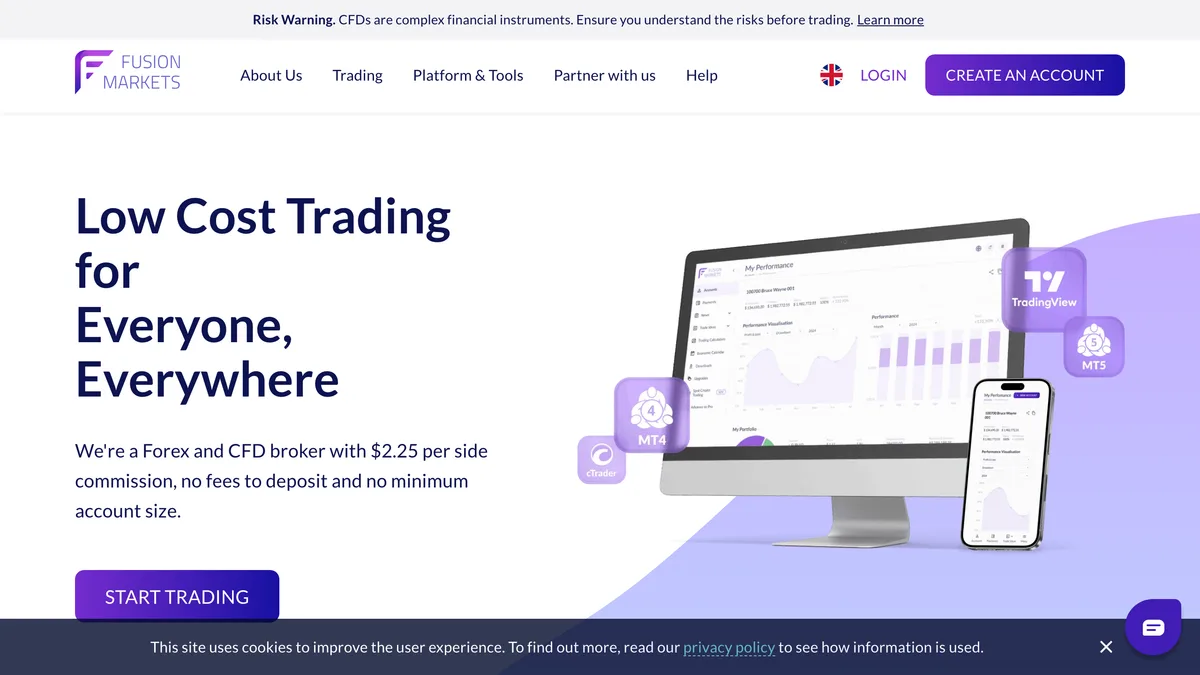
Fusion Markets is an Australian-headquartered online broker offering forex and CFD trading. The business is run out of Melbourne (South Yarra, Victoria), its founder and CEO is Phil Horner, and the brand sits within the broader Gleneagle group. The Fusion Markets brand launched around 2019, although the Australian licensing entity behind it dates back to 2011.
The product is built for active CFD traders rather than long-term investors. You get more than 250 CFD instruments, including 90+ FX pairs, around 15 indices, roughly 16 commodities, 110 US share CFDs and about 13 crypto products. There are no ETFs, no bonds and no options. The platform line-up is conventional but complete for this market: MetaTrader 4, MetaTrader 5, cTrader (on the Zero account), TradingView running on a cTrader backend, plus copy-trading through DupliTrade and multi-account management via MAM/MetaFX. Free VPS is available above 20 lots over 30 days. In short, this is a low-cost execution venue aimed squarely at people who trade often.
Our verdict
Fusion Markets is a strong choice on price and a conditional one on safety. If you are an Australian resident, you trade through a tier-1 ASIC-regulated entity with segregated client money, negative balance protection and access to the AFCA dispute scheme. That is about as good as retail protection gets. If you are most other international clients, you are routed by default to an offshore entity in Vanuatu or Seychelles with no statutory compensation scheme, no mandatory negative balance protection and leverage up to roughly 1:500. The pricing is the same either way. The safety net is not. Our score reflects the typical international reader who lands offshore, with the Australian advantage noted clearly.
We assess Fusion Markets from public sources, the relevant regulatory registers, the broker's own disclosures, and aggregated user reports. We have not opened an account or moved money through the platform.
Key features & specs
The specification sheet rewards a close read because the meaningful differences sit in the account structure rather than the instrument count. The Zero account is the reason most people come here, pairing raw spreads from 0.0 pips with a flat $2.25-per-side commission. The Classic account drops the commission line in favour of a wider all-in spread of around 0.9 pips, which suits traders who simply dislike seeing a separate charge. A swap-free option exists but applies an administrative fee after seven days that Fusion does not publicly quantify, and a Pro/wholesale tier unlocks higher leverage under strict eligibility rules.
| Attribute | Value | Source |
|---|---|---|
| Regulation | ASIC AFSL 385620 (Australian clients); VFSC & FSA Seychelles offshore for most others | ASIC register ↗ |
| Minimum deposit | No minimum account size (practical ~$10 by method) | Fusion Markets ↗ |
| EUR/USD spread (Zero) | From 0.0 pips (typically ~0.0–0.04) + $2.25 per side | Zero account ↗ |
| Round-turn cost (Zero) | ≈ $4.50–$4.90 per standard lot of EUR/USD | Zero account ↗ |
| Max leverage | 1:30 (ASIC retail); up to ~1:500 (offshore entities) | Regulations page ↗ |
| Platforms | MT4, MT5, cTrader (Zero only), TradingView, DupliTrade, MAM | Platforms ↗ |
| Instruments | 250+ CFDs: 90+ FX pairs, ~15 indices, ~16 commodities, 110 US share CFDs, ~13 crypto | Products & accounts ↗ |
| Company | Part of the Gleneagle group; founder/CEO Phil Horner; brand launched ~2019 | About ↗ |
Pricing & value
This is where Fusion Markets earns its reputation. On the Zero account, the commission is $2.25 per side, so a standard lot of EUR/USD costs $4.50 round-turn in commission alone. Adding the typical measured spread of 0.0 to 0.04 pips (0.04 pip is worth $0.40 on a standard lot) brings the all-in round-turn to roughly $4.50 to $4.90. That assumes 100,000 units per lot and $10 per pip on EUR/USD. By comparison, the Classic account costs about $9.00 to $9.20 round-turn through its ~0.9 pip spread, so anyone trading EUR/USD with any regularity is materially better off on Zero.
Set against the wider market, those Zero numbers are excellent. Many raw-spread competitors charge $3.00 to $3.50 per side, which is $6.00 to $7.00 round-turn, so Fusion undercuts the common benchmark by a clear margin. Fusion itself markets a “36% lower commissions than closest competitors” claim, which it commissioned through ForexBenchmark; we attribute that figure to Fusion rather than presenting it as our own measurement. The headline cost story holds up regardless.
Two caveats keep this from being a flawless cost picture. First, swaps sit above the industry benchmark, which makes Fusion a poor home for overnight and swing positions even though it is excellent intraday. Second, currency-conversion markup is not disclosed, and the swap-free administrative fee is not quantified. Fusion advertises no inactivity fee; we could not confirm this conclusively, and a conflicting source exists, so we suggest confirming it in the client agreement. There are $0 deposit and withdrawal fees stated, though an international bank wire withdrawal carries a $35 minimum and takes 3 to 5 business days.
Commission $2.25 per side + spread, on one standard lot of EUR/USD| Account | Min. deposit | EUR/USD spread | Commission | Best for |
|---|---|---|---|---|
| Zero | No minimum (~$10) | ~0.0–0.04 pips | $2.25 per side | Scalpers and high-volume intraday traders |
| Classic | No minimum (~$10) | ~0.9 pip all-in | None | Casual traders who prefer no commission line |
| Swap-Free | Not disclosed | Per platform | Admin fee after 7 days (not disclosed) | Traders needing swap-free conditions |
| Pro / Wholesale | Strict eligibility | Per account | Per account | Eligible professionals (up to 1:500) |
Regulation & safety
This is the most important section, and it turns on a single mechanism: entity routing. Fusion Markets operates under more than one corporate entity, and which one holds your account depends on your residency.
Australian clients trade through FMGP Trading Group Pty Ltd, which holds Australian Financial Services Licence 385620. We confirmed this licence on the register: it is current, was issued on 5 January 2011, and authorises the entity to deal in and make a market in foreign exchange and derivatives for retail and wholesale clients. The same AFSL also operates the Global Prime brand. For Australian retail clients this means segregated client money held with an Australian deposit-taking institution (the broker states NAB), negative balance protection, and access to the AFCA external dispute resolution scheme. ASIC also caps retail leverage at 1:30 on majors. This is genuine tier-1 protection.
Most non-Australian clients do not get any of that by default. They are routed to Gleneagle Securities Pty Limited, regulated by the VFSC in Vanuatu and trading as Fusion Markets, or to Fusion Markets International Ltd, which the broker's client agreement describes as an FSA Seychelles Securities Dealer under licence SD096. We attribute the SD096 reference to the client agreement rather than asserting it as a register-confirmed fact. The consequences of offshore routing are concrete. There is no statutory compensation scheme. There is no mandatory negative balance protection. Leverage can run up to roughly 1:500, which amplifies losses as readily as gains. The main third-party backstop for the offshore arm is Fusion's membership of the Financial Commission, which covers up to EUR 20,000 per claim. That is a real mechanism, but it is a private membership body, not a national investor-protection fund.
“All financial products involve risk and you should ensure you understand the risk involved as certain financial products may not be suitable for everyone. Trading in margin foreign exchange and derivatives carries a high level of risk and you may incur a loss that is far greater than the amount you invested.”
Fusion Markets Terms of Service, Sitewide risk disclosure (footer), accessed May 2026 TOS ↗
For context, regulators in several jurisdictions have flagged the Fusion Markets brand for operating without a local licence rather than for fraud. Malaysia's SC added it to an investor alert list in August 2023, India's RBI added it to its alert list of unauthorised forex platforms in November 2025, and Spain's CNMV has reportedly warned on the name. These are “not licensed in our jurisdiction” notices for restricted markets, not fraud findings, and we present them as such. There is no ASIC public warning, and FCA entries referencing “Fusion Market” are unrelated clone notices. The honest summary is this: the Fusion brand is well regulated where it is licensed onshore, and lightly regulated where most of its international customers actually sit.
What traders say
The aggregate picture is unusually positive. Trustpilot shows roughly 4.8 out of 5 rated “Excellent” across around 7,000 reviews, TradingView sits near 4.6 out of 5 from about 3,200 reviews with “Platinum” partner status, and the Google Play cTrader app holds about 4.3 out of 5 with 50,000-plus installs. The recurring praise is consistent with the spec sheet: lowest-in-class commissions, fast and tight execution on the Zero account, responsive 24/7 support, frequently fast withdrawals, and clean TradingView integration.
The complaints are fewer but worth taking seriously. The most documented event is a multi-hour platform outage at market open on 16 February 2025, which the broker acknowledged by email and for which it offered limited compensation. Beyond that single event, credible withdrawal-delay and account-closure complaint threads exist on Forex Peace Army, including an account-termination and profit-clawback dispute tied to alleged systematic exploitation. We treat these as complaint threads that exist rather than as proven outcomes. Education on the site is also thin. The fair read is a broker that most users like a lot, with a reliability blemish and a handful of serious individual disputes that keep it short of flawless.
“I've traded with four brokers in the last five years and Fusion Markets is by far the best and most importantly, cheapest. $2.25 per side commission – where else can you get that? Also has JPY accounts which is great for me swerving FX fees.”
Jorge Powl, DayTrading.com · Australia, May 2025 source ↗
“Fusion markets system froze on ctrader mt4 and mt5 on market opening on 16th 02.2025 for 2 hours they admit this and apologized by e mail, but i had a position i wanted to close and others i wanted to change, i could do nothing. DO NOT TRUST this broker to keep your deposit capital safe.”
C S Gill, DayTrading.com · UK, February 2025 source ↗
Pros & cons
The balance here is straightforward: Fusion competes on a small number of things and does them very well, while the weaknesses cluster around protection for offshore clients and reliability under stress. The lists below summarise where the evidence points.
- Class-leading Zero-account cost, roughly $4.50 round-turn on EUR/USD ($2.25 per side)
- Tier-1 ASIC regulation (AFSL 385620) for Australian clients, with segregated money and AFCA access
- No minimum deposit (practical ~$10)
- Strong platform range: MT4, MT5, cTrader and TradingView, plus DupliTrade and MAM
- $0 stated deposit and withdrawal fees
- Very high aggregate reviews (~4.8/5 Trustpilot from ~7,000)
- Fast withdrawals reported by many users; instant card, e-wallet and crypto options
- Most international clients default to an offshore VFSC/FSA entity with no statutory compensation scheme and no mandatory negative balance protection
- Swaps above benchmark make it weak for overnight and swing trading
- A real multi-hour platform outage at market open on 16 February 2025
- Credible withdrawal-delay and account-closure disputes exist on Forex Peace Army
- Several undisclosed fees (currency conversion, swap-free admin fee) and thin education
Fusion Markets vs alternatives
The natural comparison set is IC Markets, Pepperstone and Vantage. All three follow the same dual-structure model as Fusion: an ASIC-regulated arm plus an offshore entity for international clients, with raw-spread accounts at the core. That means the offshore-entity caveat is not unique to Fusion. Where Fusion separates itself is commission. Its $2.25 per side undercuts the typical $3.00 to $3.50 per side at those peers, so on pure cost Fusion matches or beats the field.
The decision therefore comes down to what you weight. If raw cost per trade is your single biggest lever, Fusion is hard to beat among ASIC-and-offshore brokers. If you want deeper liquidity reputation, broader research, or a longer track record, the larger competitors may feel more reassuring, though you will likely pay more per round-turn for it. On regulation and the offshore caveat, the group is broadly similar, so this is mostly a cost-versus-scale trade-off.
How Fusion Markets compares to the next tools in our forex brokers ranking:
| Metric | Fusion Markets | BlackBull Markets | IC Markets |
|---|---|---|---|
| Our score | 8.0/10 | 7.4/10 | 7.4/10 |
| Starting price | No minimum deposit | $0 min deposit | Min deposit unclear ($0 vs $200) |
| Best for | Cost-sensitive active intraday traders and scalpers | Cost-sensitive active traders and scalpers outside the UK who want raw spreads across multiple platforms | Active and systematic traders chasing the lowest commissions and the cTrader/TradingView stack |
| Regulation | Regulated | Regulated | Regulated |
| Full review | This page | BlackBull Markets review → | IC Markets review → |
In short: Fusion Markets leads our forex brokers ranking outright, the tools above are its closest challengers.
Who is Fusion Markets for?
Use Fusion Markets if…
Use Fusion Markets if you are a cost-sensitive, active intraday trader or scalper, especially an Australian resident who gets the full ASIC protection alongside the low Zero-account commission. It also fits traders who want cTrader or TradingView and value fast withdrawals.
Skip it if…
Skip it if you hold positions overnight (swaps are above benchmark), you need national investor-protection cover as a non-Australian client, or you want a broker with a flawless reliability record and deep educational resources.
Final verdict
Fusion Markets is a genuinely cheap, well-built execution venue with a real safety asterisk. The Zero account's roughly $4.50 round-turn on EUR/USD is class-leading, the platform range is strong, and the aggregate user sentiment is among the best we have seen. For Australian clients, the tier-1 ASIC entity makes this an easy broker to recommend on both cost and safety. For the typical international client routed offshore, the absence of a compensation scheme and mandatory negative balance protection, combined with the February 2025 outage and credible dispute threads, means the low cost comes with real counterparty risk you must accept with eyes open. We score it 8.0 out of 10: excellent value, qualified protection.
Among the cheapest brokers in the market on the Zero account, but most international clients are routed to an offshore entity with no compensation scheme. Open a demo account to try the platform risk-free, then fund a live account when you're ready. Trading carries risk.
Try Fusion MarketsFrequently asked questions
More Forex Brokers reviews
 BlackBull Markets
Some of the cheapest ECN pricing and the widest platform choice in its class, backed by a genuine NZ FMA licence, but most international clients are routed to a light-touch Seychelles entity and UK readers face a live FCA warning.
 IC Markets
Class-leading costs and a deep platform set, set against an offshore Seychelles default with no compensation scheme and a flagged regulatory record.
 eToro
eToroA trusted, Nasdaq-listed, beginner-friendly social-trading platform with great real-stock investing, held back by mediocre forex costs and an offshore Seychelles default entity for most rest-of-world clients.