
What is XM Group?
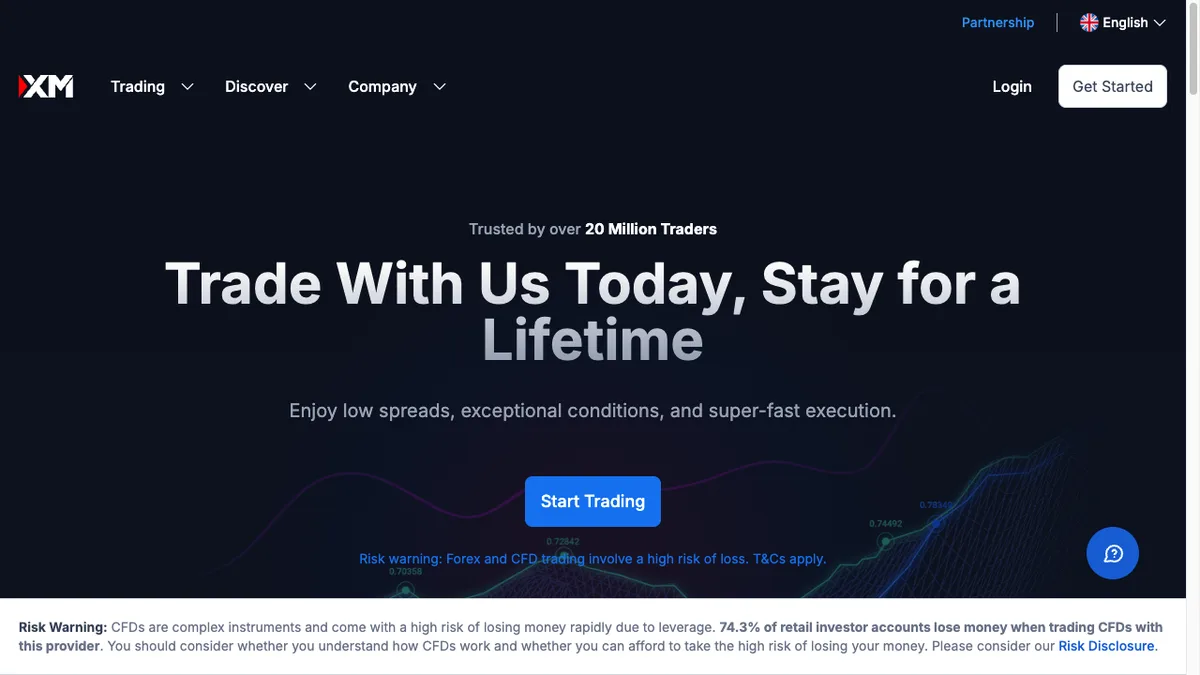
XM Group is the trading brand of Trading Point Holdings Ltd, headquartered in Limassol, Cyprus, and founded in 2009. The group also operates the Trading.com brand. XM markets itself as serving more than 15 million clients across 190-plus countries, a company claim we report rather than verify. It does not accept clients from the United States, Canada, Israel, or Iran.
The important thing to understand about XM is that it is a multi-entity group, and which entity you sign with changes your legal protection completely. Trading Point Of Financial Instruments Ltd holds a Cyprus Investment Firm licence from CySEC, number 120/10, active on the CySEC register. Clients of that entity get Investor Compensation Fund cover up to 20,000 euros, segregated funds, and negative balance protection. There is an ASIC-licensed Australian entity under AFSL 443670, now named Trading.com Markets Pty Ltd. And there is XM Global Limited, regulated by the Financial Services Commission of Belize and listed as active there. That Belize entity is the one that onboards most non-EU, non-UK, and non-Australia retail clients, and it is the one that offers leverage up to 1:1000. In South Africa, XM ZA (Pty) Ltd holds FSP 49976 but acts only as an intermediary; the actual product supplier is still XM Global Limited in Belize.
Our verdict
XM is a competent, established broker that earns real marks for its platforms, its low entry cost, its education, and its competitive Zero-account pricing, but it carries caution-warranted baggage that a careful trader should weigh before funding. The tier-1 licences are real, yet most international clients never trade under them. Combined with a principal/market-maker execution model, a multi-decade pattern of regulatory enforcement that runs right up to a November 2025 Philippine Cease and Desist order, and persistent withdrawal and profit-annulment complaints, the picture is of a capable operator whose offshore reality and history hold the score down. We land at 6.3 out of 10.
We assess XM from public registers, XM's own legal documents, and aggregated user reports. We did not open an account, deposit, or trade. Where we describe cost or execution, we are reading XM's own disclosures and the reported experience of real users, not a hands-on test of our own.
Key features & specs
The headline points are a five-dollar minimum on every account except Shares, four CFD account tiers that differ mainly on spread-versus-commission structure, a real-stocks account at 1:1, and the full MetaTrader stack on top of XM's own WebTrader and mobile app. Instrument breadth is wide at 1,400-plus markets, with platforms spanning MT4, MT5, XM WebTrader, and the XM mobile app, plus an AI assistant added in 2025 and Islamic swap-free trading on Micro, Standard, Ultra Low, and Shares accounts.
| Attribute | Value | Source |
|---|---|---|
| Regulation | Trading Point Of Financial Instruments Ltd holds an active CySEC licence (120/10); most non-EU/UK/AU retail clients are onboarded to XM Global Limited, an offshore FSC Belize entity with no compensation scheme | CySEC register ↗ |
| Australian status | ASIC-licensed via AFSL 443670 (now Trading.com Markets Pty Ltd); Australia has no statutory investor-compensation fund | ASIC register ↗ |
| Minimum deposit | $5 across Micro, Standard, Ultra Low, and Zero accounts; $10,000 on the Shares account | XM ↗ |
| EUR/USD spread + commission | Zero: from 0.0 pips + $3.50 per side (~$9 round-turn all-in); Standard: ~2.0 pips average, no commission | XM ↗ |
| Max leverage | 1:30 on major FX under CySEC; up to 1:1000 via the offshore XM Global (Belize) entity | XM ↗ |
| Platforms | MetaTrader 4 and MetaTrader 5, XM WebTrader, and the XM mobile app; an AI assistant was added in 2025 | XM ↗ |
| Instruments | 1,400+ total: 55+ FX pairs, 1,200+ stocks/CFDs, 21 equity indices, 20 commodities, 60+ crypto CFDs (not for CySEC/DFSA clients) | XM ↗ |
| Company | Trading Point Holdings Ltd, Limassol, Cyprus; founded 2009; markets 15M+ clients across 190+ countries | XM ↗ |
Pricing & value
XM's cost story splits cleanly down its account tiers, and the headline number depends entirely on which one you pick. The commission-free accounts pay through the spread. On the Standard account, third-party data puts the EUR/USD spread at around 2.0 pips on average, which works out to roughly 20 dollars round-turn on a standard lot. That is wide. The Ultra Low account narrows the gap, averaging around 1.1 pips, but it is still all-in-the-spread.
The competitive number is the Zero account. There, EUR/USD starts at 0.0 pips and averages around 0.2 pips, with a commission of 3.50 dollars per lot per side, so 7 dollars round-turn. Add the small spread cost and the all-in figure lands at about 9 dollars round-turn on one standard lot of EUR/USD per XM's own disclosures. That is genuinely competitive with the better commission-based brokers and is the account a cost-sensitive trader should look at. XM is only cheap if you deliberately choose to be on the right account; the default commission-free tiers are not the value play.
On fees, XM charges no deposit or withdrawal fees of its own, and it covers bank-wire fees on withdrawals above 200 dollars, though sub-200-dollar wires may incur one. The minimum withdrawal is 5 dollars. The fee to watch is the inactivity charge of 5 dollars per month after 90 days of dormancy, which is shorter than the dormancy window at many rivals. A VPS runs 28 dollars per month and is free at a 5,000-dollar balance plus 5 lots per month.
Commission $3.50 per side ($7.00 round-turn) + a ~0.2 pip raw spread, on one standard lot of EUR/USD| Account | Min. deposit | EUR/USD spread | Commission | Best for |
|---|---|---|---|---|
| Micro | $5 | from 1.6 pips | None | Beginners trading micro lots (1 lot = 1,000 units) |
| Standard | $5 | from 1.6 pips (~2.0 avg) | None | Casual commission-free traders |
| Ultra Low | $5 | from 0.6 pips (~1.1 avg) | None | Cost-aware traders wanting tighter spreads |
| Zero | $5 | from 0.0 pips (~0.2 avg) | $3.50 per side | Scalpers and active traders (~$9 all-in EUR/USD) |
| Shares | $10,000 | Real stocks (~$0.04/share US) | Per-share | Equity investors trading real shares at 1:1 |
Regulation & safety
This is the section that matters most, because the name on your account agreement decides what happens to your money if things go wrong. XM's Cyprus entity, Trading Point Of Financial Instruments Ltd, holds CySEC licence 120/10, which we confirmed as active on the CySEC register, with a registration number of 251334 and a licence dated 5 August 2010. Clients under that entity get Investor Compensation Fund cover up to 20,000 euros, segregated client funds, and negative balance protection. That is genuine tier-1 protection. There is also a real ASIC-licensed Australian entity under AFSL 443670, though Australia has no statutory investor-compensation fund.
The catch is who actually gets those protections. Most international retail clients are onboarded to XM Global Limited, regulated in Belize by the FSC and listed as active there. The Belize entity has no statutory compensation scheme and no mandated negative balance protection, and it offers leverage up to 1:1000. South African clients sit behind the same reality: XM ZA (Pty) Ltd is only an intermediary, and the product supplier is the Belize company. XM's own South African disclosure states that “XM ZA (Pty) Ltd acts solely as an intermediary in terms of the FAIS Act between the client and XM Global Limited (the Product Supplier).” So a trader can see “tier-1 regulated” in the marketing and still end up contracting with the offshore arm.
Execution model deepens the caution. XM is your dealing counterparty rather than a broker routing your orders to an external venue, and its own Order Execution Policy spells that out in plain terms:
“the Company acts as principal and not as agent on the Client's behalf; therefore, the Company is the sole Execution Venue for the execution of the Client's orders for the Supported Financial Instruments.”
XM Group Terms of Service, Order Execution Policy, accessed May 2026 TOS ↗
In other words, XM operates as a market-maker. It separately claims it has executed “100% of orders since 2010 with no re-quotes and 99.35% of orders in under one second,” which we report as XM's own marketing claim, not a verified figure.
The enforcement record is long and all of it is primary-confirmed. In April 2012 the CFTC ordered Trading Point of Financial Instruments Ltd to pay a 140,000-dollar civil penalty for acting as an unregistered Retail Foreign Exchange Dealer soliciting US customers, and to close all US accounts. In June 2013 CySEC fined Trading Point 5,000 euros over insufficient client-fund protection provisions and AML irregularities. In August 2015 ASIC announced that the Cyprus entity agreed to stop providing unlicensed financial services to Australians and to remove references to Australian regulation from group websites. Most seriously, on 7 November 2025 the Philippine SEC issued a Cease and Desist Order against Trading Point Holdings Limited, operating as XM, for unauthorised solicitation and sale of securities without a Philippine licence, froze its bank funds, and characterised the activity as operating “as a fraud on investors.” A separate FCA clone-firm warning against “XM Market Limited” is an impersonator, not the legitimate XM entity, and should not be confused with it.
None of this means XM is a scam. It is a regulated group with real licences. But the offshore default, the market-maker model, and a fresh, serious regulatory action are exactly the factors a safety-first reader should price in.
What traders say
XM's reputation is sharply polarised, and the split itself is informative. The main Trustpilot page for xm.com sits at roughly 3.1 to 3.3 out of 5 from around 2,900 reviews as of early 2026, with about 41 percent five-star and about 39 percent one-star. That is not a middling average; it is two opposing camps. More telling is the contrast with the Trustpilot page for the offshore xmglobal.com domain, which sits at 1.6 out of 5 from around 250 reviews, rated “Bad.” The entity that onboards most international clients is also the one with the worst public sentiment. On the app stores the picture flips: the XM app holds around 4.5 stars from roughly 125,000 Google Play reviews and around 4.5 from about 9,000 iOS ratings in India, which reflects app usability more than money-handling experience.
In aggregate, the recurring positive themes are fast e-wallet withdrawals, multilingual customer support, extensive free education through XM Academy and webinars, stable MT4 and MT5 performance, and the very low five-dollar entry. We could not verify a specific positive user quote, so we summarise that sentiment rather than attribute it. The recurring negative themes are more pointed: withdrawal delays and blocks, especially on UPI in India, on wires, and on larger amounts; profit annulment citing arbitrage or fraud clauses; the wide roughly 2.0-pip Standard spread; the 90-day inactivity fee; slippage during news; and complex bonus terms. ForexPeaceArmy hosts an active review page with multiple open withdrawal and profit-annulment disputes from 2024 and 2025.
One verified review captures the worst-case tone. A Trustpilot xm.com reviewer wrote on 25 January 2026 that a 112-dollar withdrawal requested on 16 January had still not arrived nine days later despite uploading the requested documents, signing off “don't trust on xm more scam.” A single review is not proof of a pattern, but it sits inside a documented cluster of similar complaints, and that is what gives it weight.
| Platform | Score | Sample | Source |
|---|---|---|---|
| Trustpilot (xm.com) | ~3.1–3.3 / 5 | ~2,900 reviews, highly polarised | Source ↗ |
| Trustpilot (xmglobal.com) | 1.6 / 5 (“Bad”) | ~250 reviews (offshore entity) | Source ↗ |
| Google Play (XM app) | ~4.5 / 5 | ~125,000 reviews | Source ↗ |
| Aggregate | ~3.1 / 5 | ~2,900 Trustpilot reviews (xm.com) | Normalized by TheFXGeek |
“Aggregated positive feedback centres on fast e-wallet withdrawals, multilingual customer support, extensive free education through XM Academy and webinars, and stable MetaTrader performance. We could not verify a single attributable positive quote, so we summarise the recurring themes rather than attribute them.”
Aggregated user sentiment, Trustpilot / app stores, 2026 source ↗
“I am withdrawal on 16-01-2026 today is 25-01-2026 i am upload all document bank statement also i did not get amount mail so many time there is not get proper responses amount is 112$ don't trust on xm more scam.”
Trustpilot reviewer, Trustpilot, January 2026 source ↗
Pros & cons
XM's strengths cluster around platform, cost-on-the-right-account, and accessibility; the risks cluster around offshore onboarding, execution model, and enforcement history. The lists below summarise what we found, with the most important risk being that most international clients are onboarded to the offshore Belize entity.
- Genuine tier-1 CySEC licence 120/10, confirmed active, plus a real ASIC entity (AFSL 443670)
- Competitive Zero account at about $9 round-turn on EUR/USD
- Very low $5 minimum deposit on all accounts except Shares
- Full platform stack: MT4, MT5, WebTrader, well-rated mobile app, 2025 AI assistant
- Extensive free education (XM Academy, webinars) and multilingual support
- Wide instrument range, 1,400+ markets across FX, stocks, indices, commodities, crypto CFDs
- No XM-charged deposit or withdrawal fees; e-wallet withdrawals often within 24h
- Islamic swap-free option on Micro, Standard, Ultra Low, and Shares accounts
- Most international retail clients are onboarded to XM Global Limited (Belize) with no compensation scheme and no mandated negative balance protection
- Principal/market-maker execution model: XM is the sole execution venue and your dealing counterparty
- Documented enforcement pattern: CFTC 2012, CySEC 2013, ASIC 2015, and a November 2025 Philippine SEC Cease and Desist with asset freeze
- Persistent withdrawal-delay and profit-annulment complaints; offshore xmglobal.com domain rated 1.6/5 on Trustpilot
- Wide ~2.0-pip average Standard spreads and a short 90-day inactivity trigger ($5/month)
XM Group vs alternatives
Against a tier-1-only competitor that keeps clients on its CySEC, FCA, or ASIC entity, XM's weakness is structural: a like-for-like client of one of those brokers gets compensation cover and negative balance protection by default, whereas an international XM client typically gets neither because they sit under Belize. On cost, XM's Zero account at roughly 9 dollars round-turn is in the same neighbourhood as raw-spread ECN brokers, so price is not the differentiator; it is the regulatory wrapper.
Against a true ECN broker, XM's principal/market-maker model is a philosophical difference some traders will accept and others will reject outright. Where XM clearly out-competes many rivals is breadth and onboarding ease: the 5-dollar minimum, deep education, and a polished, heavily reviewed mobile app make it one of the most accessible large brokers around. The trade-off is accessibility bought partly through an offshore entity.
How XM Group compares to the next tools in our forex brokers ranking:
| Metric | XM Group | Fusion Markets | BlackBull Markets |
|---|---|---|---|
| Our score | 6.3/10 | 8.0/10 | 7.4/10 |
| Starting price | $5 min deposit | No minimum deposit | $0 min deposit |
| Best for | Beginners and active traders who can onboard under XM's CySEC or ASIC entity | Cost-sensitive active intraday traders and scalpers | Cost-sensitive active traders and scalpers outside the UK who want raw spreads across multiple platforms |
| Regulation | Regulated | Regulated | Regulated |
| Full review | This page | Fusion Markets review → | BlackBull Markets review → |
In short: Fusion Markets edges ahead of XM Group in the overall ranking, but beginners and active traders who can onboard under XM's CySEC or ASIC entity is where XM Group makes its strongest case.
Who is XM Group for?
Use XM Group if…
Use XM if you can onboard under the CySEC or ASIC entity and therefore get real compensation cover and negative balance protection; you want a low entry cost, strong education, and the full MetaTrader stack; and you will deliberately use the Zero account for cost-sensitive, active trading rather than the wider Standard tier.
Skip it if…
Skip it if you would be onboarded to the offshore Belize entity and you are not comfortable with no compensation scheme and no mandated negative balance protection; you want a pure agency/ECN execution model rather than a market-maker; or recurring withdrawal and profit-annulment complaints, plus a fresh regulatory action, fall outside your risk tolerance.
Final verdict
XM is a real, large, established broker with genuine tier-1 licences, a competitive Zero account, low entry cost, and strong platforms and education. Those strengths are not in doubt. But the safety-first read is unavoidable: most international clients trade under an offshore Belize entity with no compensation scheme and no negative balance protection, the execution model is principal/market-maker, and the enforcement record runs from a 2012 CFTC penalty to a serious November 2025 Philippine Cease and Desist with an asset freeze, alongside a steady stream of withdrawal and profit-annulment complaints. Weighing the real platform and cost upside against the offshore default and the enforcement pattern, we score XM 6.3 out of 10: competent and usable, especially under its tier-1 entities, but a broker where the protection you actually receive depends heavily on which door you walk through.
XM pairs genuine tier-1 licences, low entry cost, and a competitive Zero account with the catch that most international clients trade under an offshore Belize entity with no compensation scheme or negative balance protection. Open a demo account to try the platform risk-free, then fund a live account when you're ready. Trading carries risk.
Try XM GroupFrequently asked questions
More Forex Brokers reviews
 Fusion Markets
Among the cheapest brokers in the market on the Zero account, but most international clients are routed to an offshore entity with no compensation scheme.
 BlackBull Markets
Some of the cheapest ECN pricing and the widest platform choice in its class, backed by a genuine NZ FMA licence, but most international clients are routed to a light-touch Seychelles entity and UK readers face a live FCA warning.
 IC Markets
Class-leading costs and a deep platform set, set against an offshore Seychelles default with no compensation scheme and a flagged regulatory record.